If there was a symbol of Hamilton’s rise, fall, and rebirth, that symbol downtown would be the Lister Block. It also was one of the jewels of the Hamilton Urban Exploration scene and could make for a fun night of exploration, which, depending on access, would see an easy group including the Lyric Theatre, Tivoli, Royal Connaught and then Lister Block. After getting out, I grabbed slices from National Pizza. But those days are long gone, Lister and Connaught being restored, Lyric long gone, and Tivoli is sealed demolished. Among all the places I explored, Lister Block is one that I was around when it was active. I probably even saw it once in its last days, saw it abandoned, and then saw it restored and active again. It was always a favourite, and I’m glad it is still around and not a parking lot.
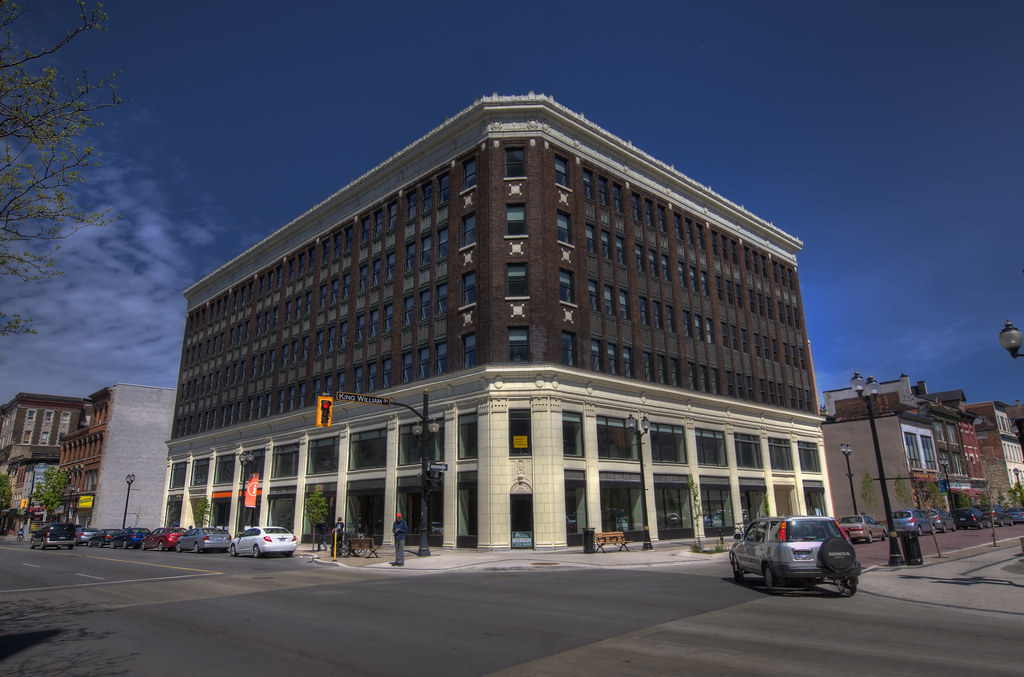
Nikon D300 – AF-S Nikkor 14-24mm 1:2.8G
Joseph Lister first came to Canada in 1832, along with his family. The son of the famous British doctor of the same name, the younger Joseph, decided to go into business rather than the medical field. Joseph settled in Hamilton and established a dry goods store on James Street at King William. Even in the 1830s, the choice was interesting as the city’s commercial centre was around John Street. The first few years of his operation were hit and miss, but he slowly gained a name for himself. When Sir Allan McNab began to be involved in opening a new railway line in the mid-century. McNab had arranged to run the rail line through Hamilton, cutting across James Street a kilometre from Lister’s store. Lister proceeded to buy up the block and, in 1852, opened up a new multi-use building bearing his name, Lister Chambers. The Chambers had retail, office, and residential spaces, making it the first known mixed-use building in the Province. When the Great Western Railway opened a year later, it quickly became the hottest commercial address in the city. It reshaped the downtown, shifting to James Street rather than John Street. After Joseph died in 1892, the business fell to his son, J. Edmund Lister. By the 20th Century, the Chambers were home to twenty businesses, over one hundred offices and a handful of private apartments. But disaster struck in the early hours of a cold February 1923 day. A fire started in the back of a clothing retailer and quickly spread through the wooden interior. The Hamilton fire brigade threw everything they could at the building to knock down the fire, but there was little hope to salvage the building. Dumping as much water as possible, they moved to freeze the fire. The fire caused over a million damages (17.5 million in 2024) and destroyed almost every business. Undaunted, Lister demolished the old building and began reconstruction a year later. Hiring Bernard Prack as the architect, Prack designed a new neo-classical building with white terracotta details and a brown brick facade. The structure’s interior would be of steel-reinforced concrete to fireproof the building. The new Lister Block opened in May 1924, featuring a unique first-floor L-shaped arcade with two street accesses and several stores having both interior and exterior entrances. Additional shops could be found on the second floor, while the top four floors house professional offices that are topped out at six storeys. The Lister Block is often called the first indoor mall in Canada. Hamilton and the Block rode out the Great Depression and through the war years.
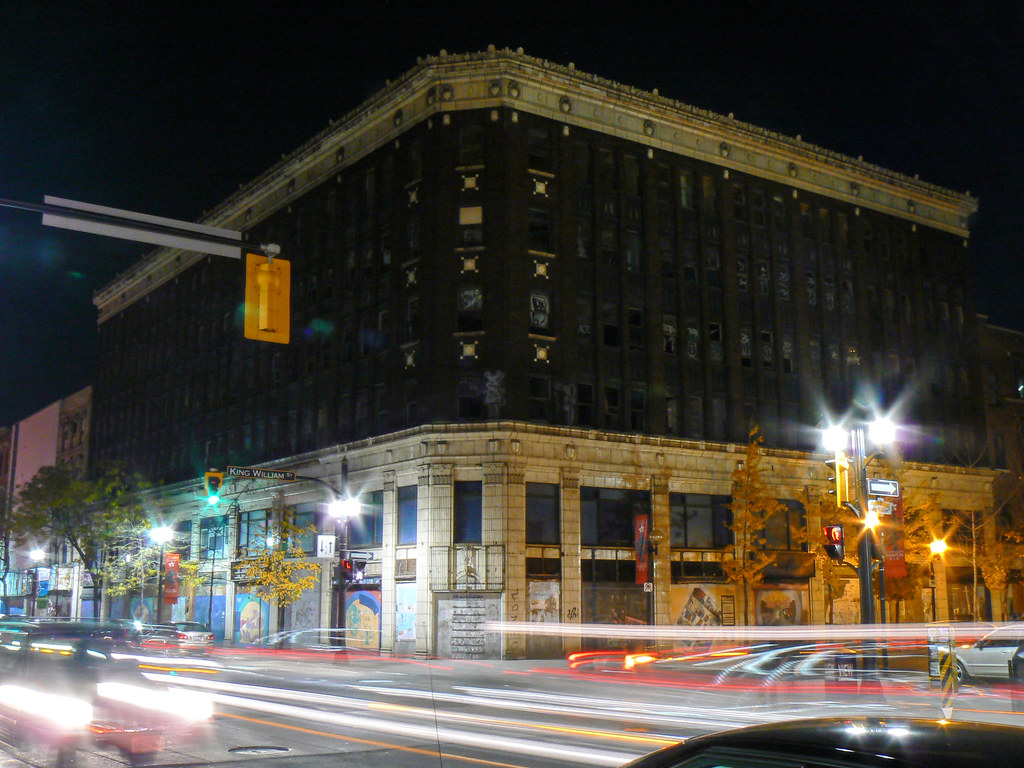
Panasonic Lumix DMC-FZ7 – Leica DC Vario-Elmarit 1:2.8-3.3/6-72 Asph.
Nikon D70s – Tamron SP AF 11-18mm F/4.5-5.6 Di-II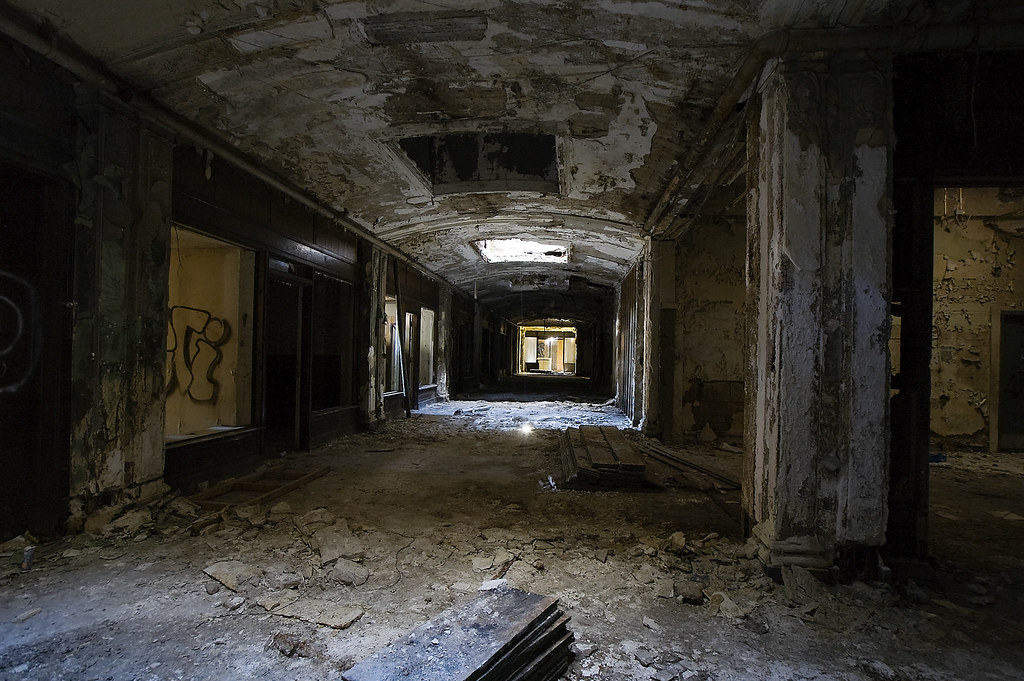
Nikon D70s – Tamron SP AF 11-18mm F/4.5-5.6 Di-II
Nikon D70s – Tamron SP AF 11-18mm F/4.5-5.6 Di-II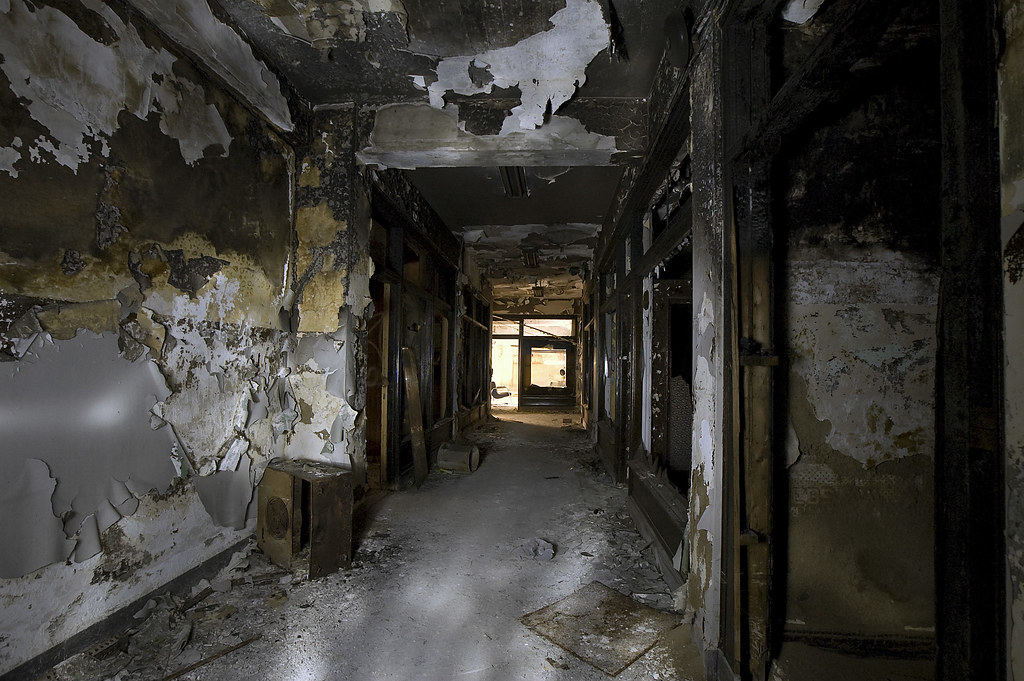
Nikon D70s – Tamron SP AF 11-18mm F/4.5-5.6 Di-II
But even in the post-war economic boom, the shift in population would begin to see the Block’s decline. Those who lived in the city’s core moved out into the suburbs with new malls to serve their needs, and the Block could not adapt to the rise in immigration into the city centre. The Lister Block would slowly fade from relevance, but with the growing bureaucracy in the city, the government saw the old City Hall face a space issue. The government explored leasing office space in the Lister Block directly across the Block. However, the need for additional space disappeared when the new City Hall opened in 1961. The opening of a new Eaton’s Store and the Jackson Square Mall, combined with a general economic decline through the 1970s and 1980s, put the writing on the wall for Lister Block. In 1985, only a handful of tenants still held onto their storefronts when the Block was purchased by Gorham Developments. While Gorham’s plans for the property were unknown, they evicted the last tenants in 1995. The city quickly slapped a Heritage designation on the building, and the Province followed a year later. The Block became a symbol of Hamilton’s decline; it soon became home to the unhoused, and it survived a few fires. In 1999, the Labourers International Union of North America (LiUNA), fresh off their restoration of the old Canadian National Station, purchased Lister Block with plans for repair and reuse. During this period, the Lister Block was used in the filming of Silent Hill and was the set for a music video from Three Days Grace. Restoration efforts would not start until 2009, with the exterior covered in scaffolding and the interiors stripped to the superstructure. The entire building came under threat in 2010 when the Lister Annex building collapsed, but the main structure was stabilised. In 2011 the newly restored Lister Block reopened as a mixed-use space, with first-storey storefronts and office space through the remainder. In a strange twist, several departments from the City of Hamilton now occupy the top floors of Lister Block.

Nikon D70s – AF-S Nikkor 18-70mm 1:3.5-4.5G DX
Nikon D70s – AF-S Nikkor 18-70mm 1:3.5-4.5G DX
Nikon D70s – AF-S Nikkor 18-70mm 1:3.5-4.5G DX
Nikon D70s – AF-S Nikkor 18-70mm 1:3.5-4.5G DX
Nikon D70s – AF-S Nikkor 18-70mm 1:3.5-4.5G DX
I am sure I saw Hamilton near the end of its life when I was little and regularly visited Hamilton with my mom and brother to see my Oma Oosthoek. I don’t know if it’s true, but I’ll enjoy that personal head cannon. My first real trip to Lister came in 2006 during a Hamilton Urban Exploration meetup; it had been several years since I was last in downtown Hamilton. Any trips into the city were to visit family. They lived on the mountain, and most of my exploration meets were in Toronto. The Hamilton crew was suspicious about new people and protective of their locations. What also made things interesting with Lister Block is that it is in the middle of downtown, highly visible and highly public. By 2006, restoration was still a few years away, but the building was owned by LiUNA. But I can honestly say I had a lot of fun in that first meetup, saw some interesting things, and tried to trace down the names of some of the businesses like “Grand Hotel” and “Epicure Gourmet & Gifts”, which yielded nothing. I would eventually learn that these were leftovers from filming “Silent Hill”, where the Lister Block was used as the “Grand Hotel” in the titular town. Despite the public nature of the location, access during the day was surprisingly easy. Besides finding a makeshift guard hut at the back, I have yet to encounter any security. Eventually, as the building moved towards restoration, efforts were taken to secure the Block. There always was a way in, simply because it had become home to the unhoused of Hamilton. The explorers took advantage of it, but using the building as a shelter also added a bit of danger, not from structural collapse but from needles and other objects left behind. Honestly, I enjoyed the daylight trips more than the nighttime ones; you had to be extra careful at night with flashlight use as most of the upper-floor windows were open, but you could certainly get some cool rooftop shots. The last trip into the Block, when it was still abandoned, was in 2008; by 2009, the restoration work had started. I never had any negative encounters at the Lister Block, and there were no close calls or run-ins with security, police, or the unhoused. Access was always easy, and it was always a ground-level entry either through a broken window or door. After the annex collapsed in early 2010, I took the chance to check out the building under renovation, and it looked so different but gave an appreciation for the heavy-duty construction of the superstructure. It wasn’t until the Block reopened in 2012 that I learned how loved the Lister Block was as the grand opening of the arcade was packed. I had a much better time attending Doors Open events in 2012 and 2013. And even got a little bit more behind the scenes when I visited with my father-in-law, who has his office in the Lister Block.
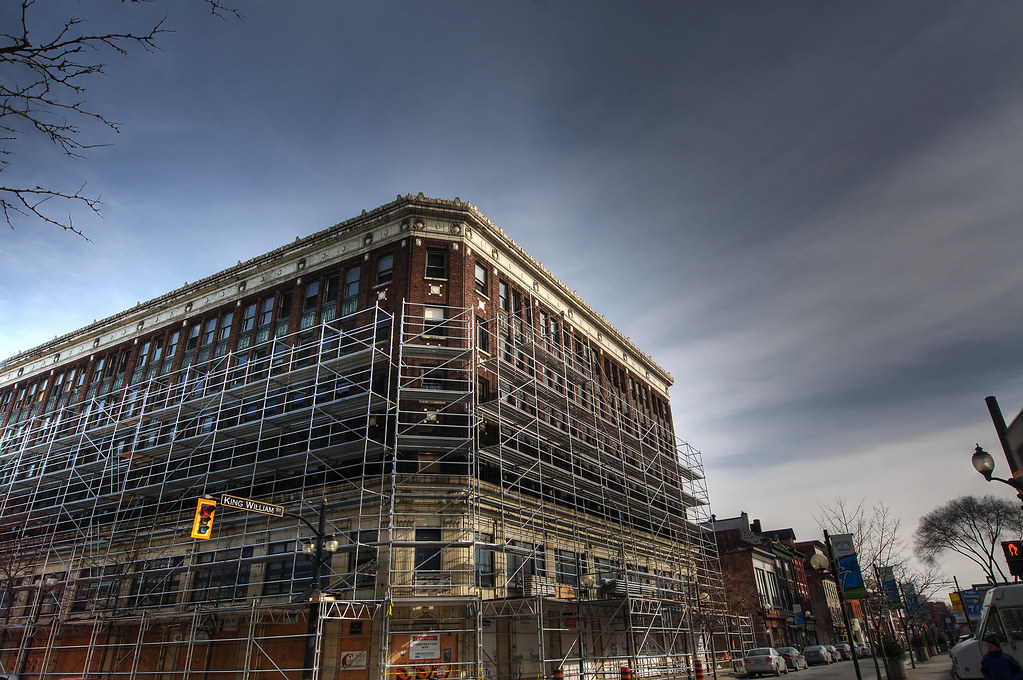
Nikon D300 – AF-S Nikkor 14-24mm 1:2.8G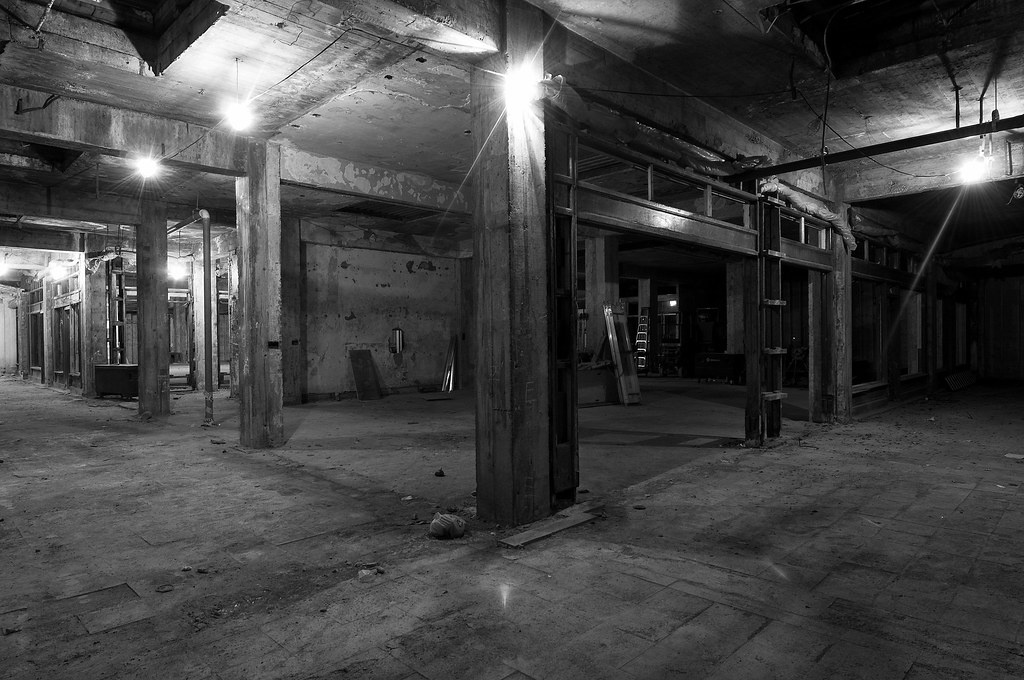
Nikon D300 – AF-S Nikkor 14-24mm 1:2.8G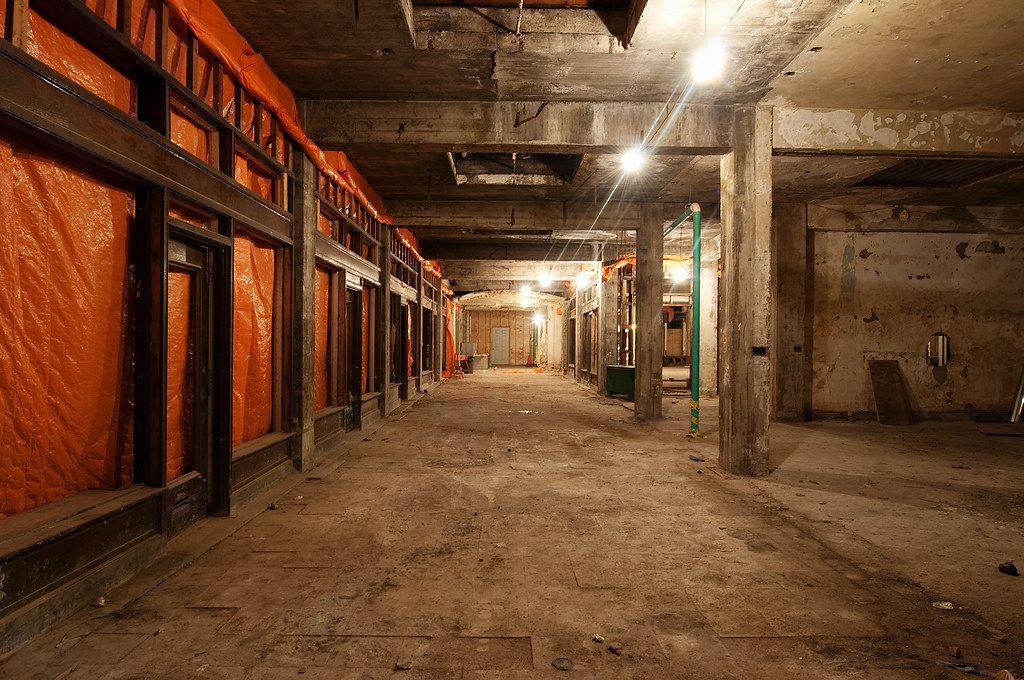
Nikon D300 – AF-S Nikkor 14-24mm 1:2.8G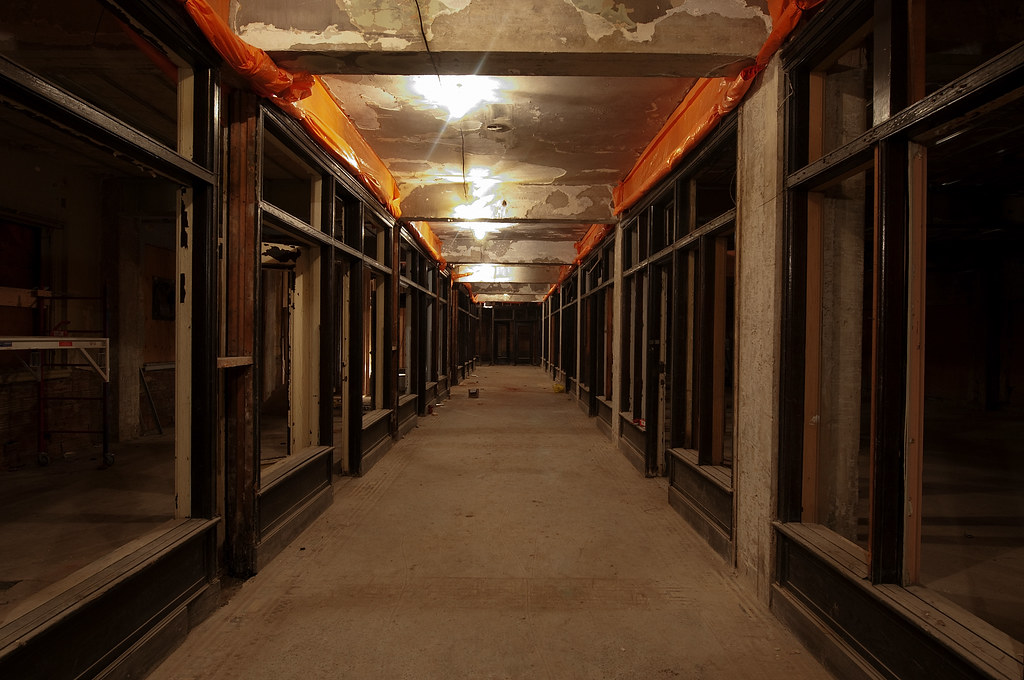
Nikon D300 – AF-S Nikkor 14-24mm 1:2.8G
Nikon D300 – AF-S Nikkor 14-24mm 1:2.8G
I have used almost every camera I’ve worked with the capture Lister Block, from my Konica-Minolta DiMAGE Z2, the brief time with the Panasonic FZ-7 and all three of my SLRs (D70s, D300, D750) and a few film cameras also (Minolta X-7a, Pentax K1000, and Bronica SQ-Ai). But the one thing that struck me was that even back in 2006, I started to use leading lines and wide angles to capture the space inside the block. But my compositions were all over the place, and while I did have some good photos, they were only sometimes that way. On the first trip, I had a couple of good shots. The rest had a more rushed feel. During my trips, I played with adjusting exposure manually to achieve different looks, often with the help of plugins during post-processing. I also worked with light panting using a manually fired flash or a flashlight. While some of these did not turn out well, others were pretty good even today. I even worked with HDR images and learned how to not overcook the images. The term clown vomit was often used to describe some of the edited techniques of the time. Urban Exploration allowed me to try techniques in a space with ever-shifting conditions. The one thing that stands out to me in these images is that of repetition; I captured some of my best images during a trip in the summer of 2009, highlighting some of the key areas of the first-floor arcade and second-floor shops. On a side note, I ended up editing the 2009 shots twice because the first time, I had been working in the wrong colour space for processing RAW images (it was my first time). I went back and captured these benchmark shots in 2010 during the restoration phase and finally in 2012 when the Block was fully restored. I only shot a couple of rolls of colour film inside while it was abandoned, but I did get a square format camera and black & white film (FP4+) during a Doors Open trip. I see a lot of positive growth in these shots, from my first visit in 2006 to the most recent one in 2022.
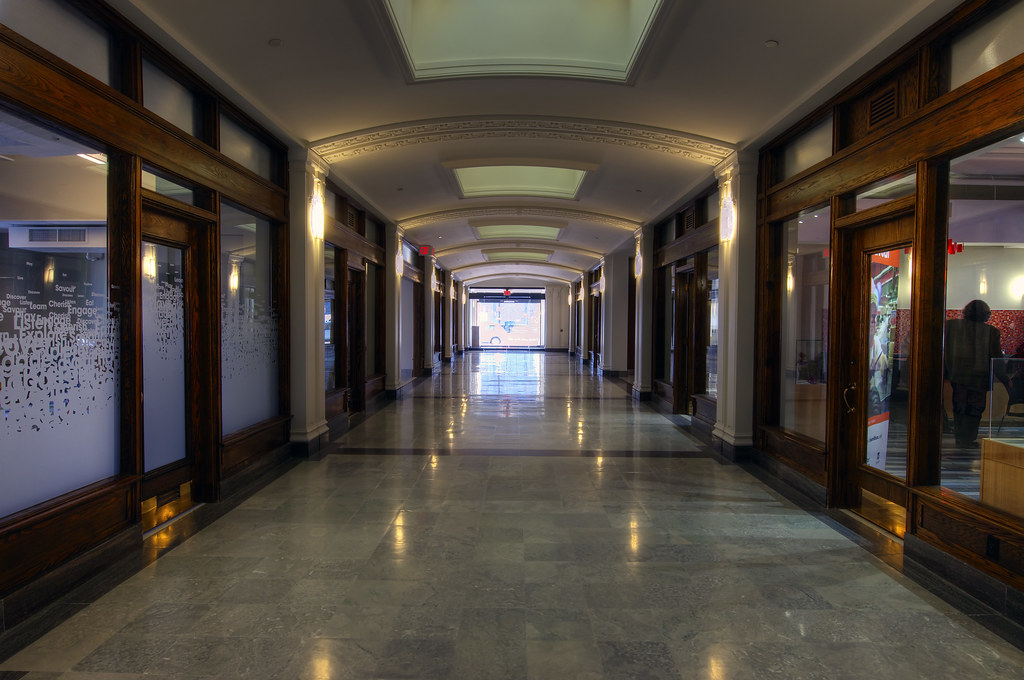
Nikon D300 – AF-S Nikkor 14-24mm 1:2.8G
Nikon D300 – AF-S Nikkor 14-24mm 1:2.8G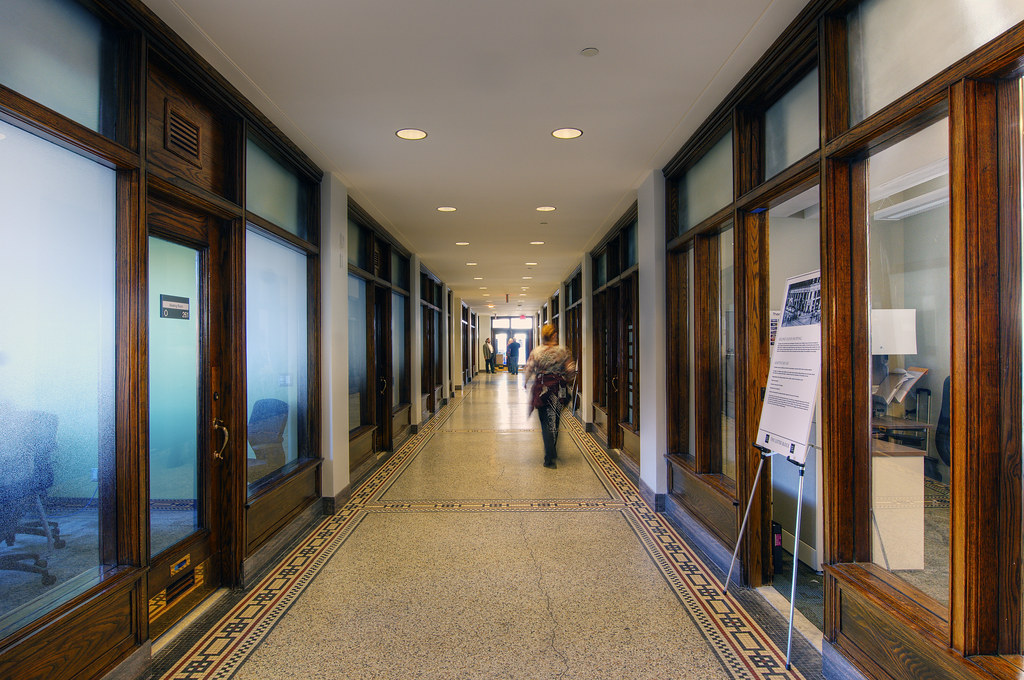
Nikon D300 – AF-S Nikkor 14-24mm 1:2.8G
Nikon D750 – AF-S Nikkor 14-24mm 1:2.8G
Nikon D750 – AF-S Nikkor 14-24mm 1:2.8G
Like everything with downtown Hamilton, the slow efforts to restore the downtown have taken years. The city has been in a slow recovery since the 2000s but still suffers, with many of the unhouses and buildings left rotting, abandoned, and often collapsing. While places like Lister Block and the Royal Connaught are shining examples of adaptive reuse and restoration along with several other buildings along James, King & Main, these are contrasted by the long lineups for food services that run on Saturdays in Gore Park as the buildings are only accessible as housing to a select few. But that is another problem that needs to be addressed. I am glad that Lister Block survived and didn’t turn into a parking lot; I still make a point to capture it whenever I walk by; in fact, one of my earliest shots on 4×5 was of the Lister Block. What makes the Lister Block unique in my explorations is that I have several albums to feature the building, if you want to see more of the building when it was abandoned check out the exploration album, for the restored building here are ones from my Doors Open trips in 2012, 2013 and 2022.