Within the Canadian Mythos of our nation, there are several events, call them fixed points in the timeline, that have been arbitrarily assigned to build the Canada we live in today. These points are, of course, all post-contact with the Europeans, but that’s a discussion for another time. You can look at the arrival of the French and the founding of Quebec City and Montreal. The French and Indian War that established British rule, the American Revolution, the two attempted invasions, and the arrival of the Loyalists. The War of 1812, which saw the American invasions repeatedly tossed back. The Canadian Confederation in 1867. Would Canada still be Canada without these events? In the case of these previous events, we would not have the Canada we have today. But there are some that could have gone differently, and they wouldn’t affect us as a country. And one of the events often held up as a great moment of nation-building is the Battle of Vimy Ridge. Today marks the 109th anniversary of the start of the battle, so I thought, why not write about the battle like I would some of my other history projects?

Sony a6000 – Sony E PZ 16-50mm 1:3.5-5.6 OSS
One of the defining parts of World War I, and more specifically the Western Front, is trench warfare. Endless lines of trenches separated by a bombed-out no-man’s land with endless kilometres of barbed wire, machine guns, and artillery. Basically, industrialised killing. Now, the causes of World War I are many, and I’m not going to get into it here. World War I started in 1914, and the war’s initial moves were rapid as both sides sought an advantage by outflanking each other. The actions from September to October 1914, known as the race to the sea, saw vast parts of Belgium and France overrun by rapidly advancing troops and battles before settling into the drudgery of trench warfare by October. It was during this period that the Germans captured Vimy Ridge. The ridge is a natural high ground overlooking the Douai Plains, about eight kilometres north of Arras and outside the village of Vimy. From October, the French 10th Army would oppose the Germans who defended the ridge. The French would twice attempt to retake the ridge in May and September 1915 during the second and third battles of Artois. Both attempts would fail, resulting in a total of 150,000 casualties. In February 1916, the British XVIII Corps would relieve the French in the sector. The British troops soon discovered a series of tunnels and explosives rigged mines designed to blow up under the formerly French-occupied areas. British commanders were quick to send in their own tunnelling experts to counter the Germans. The British never made any push to capture the ridge aside from the usual trench raids and skirmishes that often took place between the big battles. The only real action occurred on 21 May 1916, when the Germans attempted to push the British back further but were repulsed. The British XVIII Corps were relieved in October 1916 by the Canadian Corps.

Sony a6000 – Sony E PZ 16-50mm 1:3.5-5.6 OSS
Sony a6000 – Sony E PZ 16-50mm 1:3.5-5.6 OSS
Sony a6000 – Sony E PZ 16-50mm 1:3.5-5.6 OSS
The German 6th Army defended the ridge since the earliest days of the war. The 6th Army consisted of three infantry divisions and supporting artillery and was under the overall command of Generaloberst Ludwig von Falkenhausen. Most of the men who made up the 6th Army were Bavarian; by this time in the war, many other German peoples were beginning to fill the ranks, and units now included those from Prussia. You have to remember that Germany, as a unified nation, was still less than 100 years old by World War I, and many formerly independent states retained a strong sense of pride in their heritage. While there was a mix of field and heavy artillery, von Falkenhausen depended on machine guns for the main defence of the ridge. The Germans also had two years to build an extensive system of defences along the ridge, including multiple trenches, tunnels, mines, bunkers, and barbed wire. The problem is that the entire defence of the ridge was rigid, making it difficult to apply the new elastic defence, or defence in depth, now being ordered by the High Command and Generaloberst Erich Ludendorff. The idea was to draw the attackers in, allowing them to break through strategic areas, then pull them into pre-sited areas and finish them off. The Canadians had been in the war since 1915, seeing their first major action on 22 April 1915 and proved themselves capable soldiers during the Second Battle of Ypres. Originally, the four Canadian divisions had been attached to larger British formations, but they were now grouped under a single command, Lieutenant-General Julian Byng. And it wasn’t just the Canadians; a division of British troops was also stationed with them, along with a vast array of artillery, a mix of both British and Canadian batteries. In the air, five squadrons from the Royal Flying Corps provided air superiority, reconnaissance, and artillery spotting roles. While the French planned their Nivelle Offensive, it was decided to draw the Germans away and relieve pressure on the French by having the British capture Arras, while the Canadians would take Vimy Ridge. The British and Canadian commanders would learn from the French during the bloody Battle of Verdun and develop a new tactic to better capture the heavily defended ridge. The infantry would advance behind a carefully coordinated and timed artillery barrage, which would fire ahead of the infantry, clearing the path along the six-kilometre front. All four Canadian divisions would be involved with smaller formations leapfrogging to maintain the forward momentum. Four objects were laid out, and the forward German positions were designated as Line Black, Hill 145, which marked the highest point and was designated as Line Red. Once those two objectives were captured, the village of Thélus and the woods around Vimy were designated Line Blue and the final objective, the final set of German trenches or Zwölfer-Grahen, were designated Line Brown.
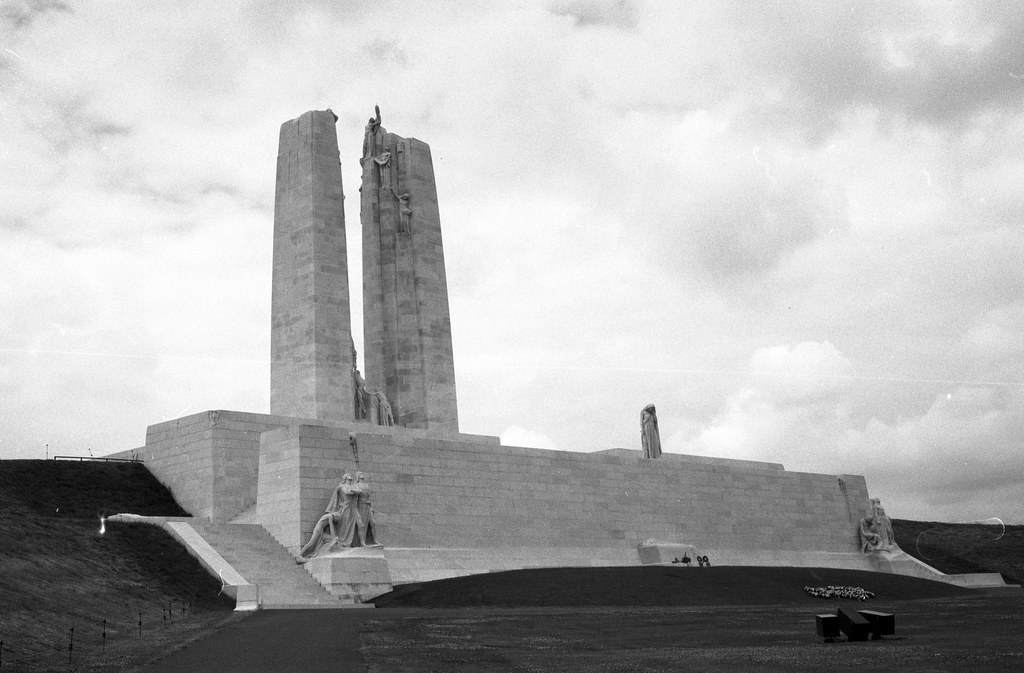
Kyocera Contax G2 – Carl Zeiss Planar 2/45 T* – Kodak Panatomic-X @ ASA-32 – Kodak Xtol (1+1) 7:30 @ 20C
Kyocera Contax G2 – Carl Zeiss Planar 2/45 T* – Kodak Panatomic-X @ ASA-32 – Kodak Xtol (1+1) 7:30 @ 20C
Kyocera Contax G2 – Carl Zeiss Planar 2/45 T* – Kodak Panatomic-X @ ASA-32 – Kodak Xtol (1+1) 7:30 @ 20C
What distinguished the preparations for the assault from many others was that engineers built a full-scale training course well behind the lines, and every soldier who would be part of the attack trained on it as timings and methods were perfected. Among the commanders who conducted the training and helped create the strategies was Canadian Major General Arthur Currie. General Currie at the time commanded the 1st Canadian Division. While the officers appreciated the effort, many of the common soldiers saw it as the officers playing. All the while, the Canadians and British maintained pressure on the Germans through artillery, raids, and tunnelling. What the high command did not expect was that in February 1917, a German-born Canadian defected to the Germans and revealed the whole plan; this was later corroborated and filled in by prisoners of war under questioning. While the Germans planned to disrupt the attack, they did not expect a blistering artillery bombardment that began on 20 March 1917. Heavy artillery pieces were placed every eighteen meters. Guns like the 12-inch howitzer, 60-pound gun, and 9.2-inch howitzer. These were supplemented by field pieces every nine meters, the 18-pounder. These fired in half-strength to conceal their numbers. The goal of the initial bombardment was to demolish the defensive positions and barbed wire. This was facilitated by the use of a special fuse timer to ensure the shells detonated at the appropriate time to maximise damage. Tunnellers dug a massive mine and armed it with explosives as part of the preparation. After a week of the initial bombardment, the guns all fired together, this time directly at the Germans, starting on 2 April 1917. The week’s worth of bombardment had torn up much of the Germans’ supply lines, and now being directly targeted only added to the drop in morale. The heavy bombardment prevented supplies and rations from reaching the front and also disrupted sleep. To preserve his reserves, von Falkenhausen marched his reserve battalion twenty-three kilometres behind the front. It became known as the week of suffering by German troops. On the night of 8 April, the guns kept up their barrage while the troops moved into position. The 1st Canadian Division assaulted in the south, with the 4th Canadian Division at the northernmost point and the 2nd and 3rd Divisions in the middle. The 4th Division faced the most heavily defended section of the ridge, known as the Pimple.

Sony a6000 – Sony E PZ 16-50mm 1:3.5-5.6 OSS
Sony a6000 – Sony E PZ 16-50mm 1:3.5-5.6 OSS
Easter Monday, 9 April 1917, saw bad weather sweep across the area, snow, sleet and wind. But despite this, it worked in the attackers’ favour, blowing into the German positions. At 5:30 am, the massive mine under the German positions detonated, blowing a large communication and path. The artillery opened up, starting the creeping barrage. The whistles sounded, and the men advanced. The Germans countered with their own artillery and machine gun fire, but the previous two weeks’ worth of barrages left them short of shells, and many of the animals used to move the guns had been killed. The 1st, 2nd, and 3rd divisions advanced as planned and much faster than even the Germans realised. German positions were quickly overrun as the Germans retreated in confusion. Within an hour, they had all reached the Line Black objectives and captured the German forward positions. Only the 4th Division lagged behind; they faced the heaviest resistance along the entire front, and their advance quickly collapsed. The carefully timed artillery barrage had moved too far forward to support the advancing troops; the 4th Division would have to fall back and regroup. But that didn’t stop the rest of the advance: by 7:00 am, the 1st Division had reached Line Red, the 2nd Division had captured Les Tilleuls, and the 3rd Division was coming up behind. But with the continued resistance by the defenders of Hill 145, a gap in the flank of the 3rd Division was opened to a counterattack. Commanders adjusted and manoeuvred to defend their flank, but the speed and ferocity of the Canadian attack left the defenders unable to exploit the gap, and they were again forced into retreat. By the afternoon, the German defenders on Hill 145 had expended nearly all their ammunition, allowing the 4th Division to regroup and mount a concentrated attack that captured the hill. The victory, however, was short-lived: an attack by the German 79th Reserve Battalion forced the Canadians off the hill, but not far. As night fell, the two sides began to plan for the next day as British reinforcements moved up to hold the ground that had been captured. By 9:30 am on 10 April, three British brigades and two tank squadrons had moved up to support the further advance. This freed up the 1st and 2nd Canadian Divisions to continue their advances, capturing Hill 135 and the village of Thélus, reaching the Line Blue Objectives. After an hour’s rest to regroup and rearm, the advance continued by 1:00 pm. Heavy defensive fire caused mass casualties and knocked out the British tanks. Despite the heavy defence, the Canadians reached Line Brown within the hour. The 4th Division continued to struggle with their objective, attempting to regain Hill 145, but this time pushing the defenders back to the small salient known as the pimple. Despite being surrounded and under continued attack by the Canadians, who were now pouring everything into capturing the hill, the defenders retained control. By nightfall, it was the only section of the ridge that remained in German hands. Seeing no chance, von Falkenhausen ordered troops to retreat to a new line of defence and to burn everything behind them.

Sony a6000 – Sony E PZ 16-50mm 1:3.5-5.6 OSS
Sony a6000 – Sony E PZ 16-50mm 1:3.5-5.6 OSS
Sony a6000 – Sony E PZ 16-50mm 1:3.5-5.6 OSS
As 11 April dawned, the carnage of the battle was beginning to be evident; no major actions occurred, but there was plenty of troop movement as the Canadians moved fresh troops forward for a final push on the pimple. The Germans also took advantage of the pause, allowing von Falkenhausen to rotate out the battered Bavarians and replace them with fresh troops from the Prussian 4th Guards. Artillery continued firing on both sides, while engineers deployed gas projectors into Givenchy-en-Gohelle to spread chaos, confusion and death among the Germans. The Germans continued their retreat to their new defensive position, the Oppy-Méricourt line. At 4 am on 12 April, the 4th Division began their fresh advance on the pimple. The initial attack was quickly thrown back, but it gave time to better sight in the artillery before the 10th Canadian Brigade charged in again. It would take more than twelve hours before the defenders were finally evicted from the pimple. By the time the fighting was done, the Canadians had suffered 7,004 wounded with 3,598 dead. Some 4,000 Germans were taken prisoner with casualty estimates showing 20,000 on the German side. While the attacks on Vimy and Arras were successes, the whole Nivelle Offensive collapsed, forcing British and Canadian troops to continue fighting the Germans to keep pressure off the French as they retreated. Ensuring that they could never exploit their victories, nor did the Germans attempt to retake Vimy Ridge. In fact, because of this, the Germans did not view their losses as actual defeats. For his failure to deploy the new defensive strategy, von Falkenhausen was removed from field command and appointed as military governor of Belgium for the rest of the war. In that role, von Falkenhausen ruled with an iron fist, executing some 170 civilians, he would die in 1936. General Sir Julian Byng would be promoted to the rank of full General and given command of the British Third Army, staying in that role until the end of the war. He went on to serve as Canada’s Governor General. After returning to England, he was created Viscount Byng of Vimy and died in 1935. General Arthur Currie was granted the temporary rank of Lieutenant-General and appointed Knight Commander of St Michael & St George by King George V and given command of the Canadian Corps, a position he held until the end of the war. However, when he returned to Canada after the war, he received a lukewarm reception. Deeply unhappy, he retired from the Military and continued to face trouble for his actions during the war. Currie had made several enemies in political circles. Curried died in 1933. Four Canadians would be awarded the Victoria Cross for their actions at Vimy Ridge, two posthumously. In 1922, France granted a large plot of land on Vimy Ridge where the Canadian Government planned to erect a national war memorial to the Canadians who died in World War I. Walter Allard would win the design contest, and his memorial would be dedicated in a grand ceremony in 1936. After the Fall of France during World War II, there had been rumours that the memorial had been destroyed; the opposite was true. Adolf Hitler (who had fought in World War I) saw it as a peaceful place and ordered the elite Waffen SS to stand guard. The site was liberated in 1944.

Sony a6000 – Sony E PZ 16-50mm 1:3.5-5.6 OSS
Nikon D750 – AF-S Nikkor 28-70mm 1:2.8D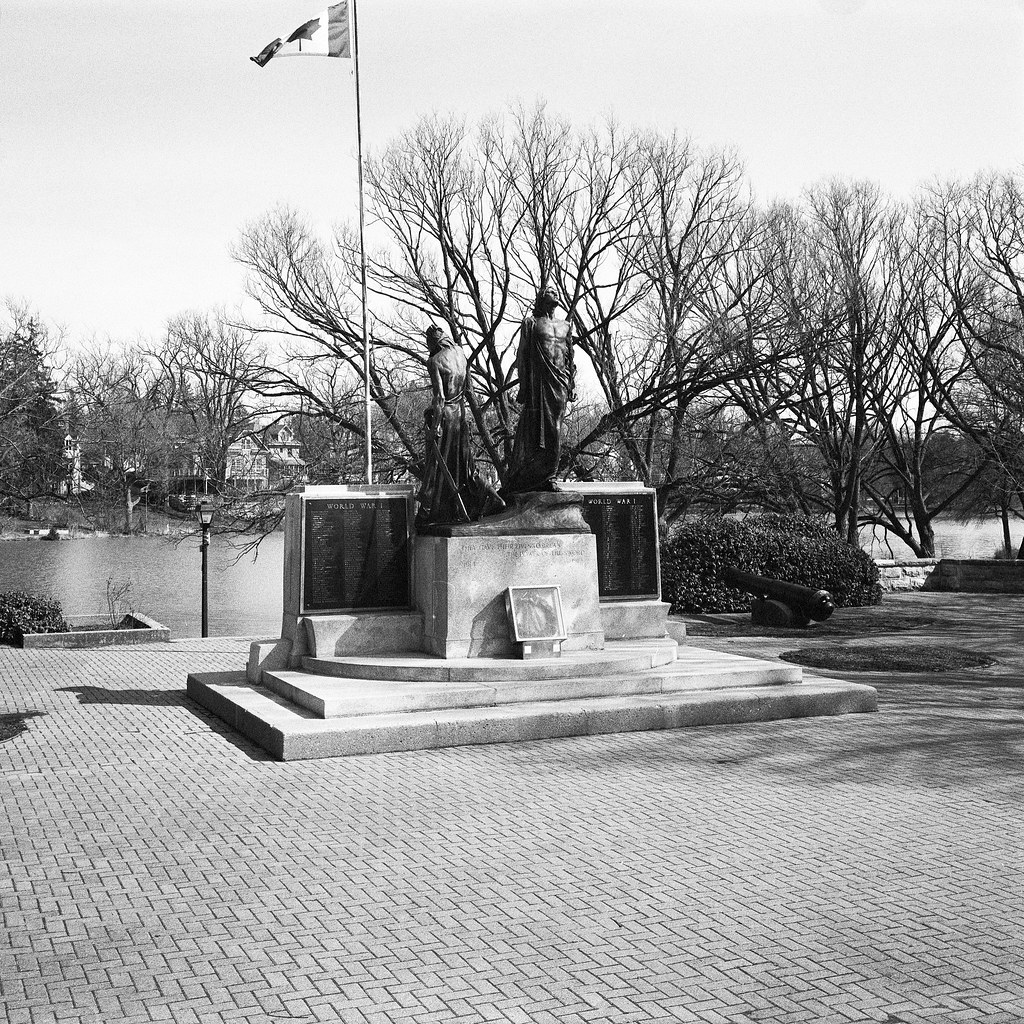
New Mamiya 6 – Mamiya G 1:3.5 f=75mm L – Kodak Tri-X 400 @ ASA-250 – SPUR HRX (1+17) 10:00 @ 20C (Constant Rotation)
In the big picture, the Battle of Vimy Ridge was not a major engagement during the war. It did not produce a major breakthrough that could be exploited, and the collapse of the Nivelle Offensive necessitated several additional battles to prevent further French casualties. The German assessment of the situation was correct; it was neither a major victory nor a loss. But it did one thing: it was the first time all four Canadian divisions fought together as a single unit, with British units providing support. It also reinforced the Canadian reputation as feared troops; Canadians could put the Kaiser’s army to flight, which was significant. The nickname “Stormtroopers” was given to them by the Germans. Now, the action at Vimy Ridge and the loss of life by Canadian troops is not to be diminished by any of this, and it is a battle whose name is engraved on almost every cenotaph across Canada. However, the idea that Vimy was a major nation-building event is a modern one. The idea began to be discussed after World War II, when most of those who had fought had died. Was Vimy a major nation-building event? Probably not, Canada would still be Canada even if we hadn’t captured the ridge. But for the legend and myth that is Canada, Vimy is a perfect addition; it’s acceptable to take a critical look at these things. If you do have the chance, I highly recommend visiting Vimy Ridge and the memorial if you’re in the area or can make it work. But you don’t have to look too far; there are echoes of Vimy all across Canada.