It’s always fun to revisit trips on anniversaries. Last year, I posted about the ten-year anniversary of my epic three-week trip to Europe to participate in the 200th Anniversary Reenactment of the Battle of Waterloo. And I was recently thinking about the last time I did a big trip, and after someone favourited an old image from my NOPEX trip back in 2011, I realised that this year marked the 15th anniversary of that trip. So, for a bit of context, NOPEX, or “Northern Ontario Products Exposition,” was a week-long car-camping trip through Northern Ontario with my good friend James. The groundwork had been laid with a pair of trips in 2009 and 2010, or MAYPEX, because they took place over the May long weekend. Now I had always planned for the NOPEX trip to be a larger group, but that never materialised. But on 16 July 2011, James and I loaded my car and drove from Oakville to North Bay. Sadly, I didn’t collect many images on that trip because I was mainly driving, but we did make one stop north of Orillia at Webbers, an iconic burger stand, because tradition. We made camp just outside of North Bay and met up with a fellow PYPSer (both James and I were alumni at that point). So it was really the following day that the journey began.
One thing to note, I’m working on this post strictly from memory and the visual record that both James and I captured. Thankfully, there’s enough on that record to figure out what happened, where we went, and what we did. It may not be entirely accurate.

Kyocera Contax G2 – Carl Zeiss Planar 2/45 T* – Lomography X-Pro 100 @ ASA-100 – Processing By: Silvano’s
Day One – North Bay & Temagami
After driving for several hours on Saturday, we wanted a short hop on Sunday. But first, we needed to explore North Bay a little bit. After breaking camp, we headed into downtown, checking out the former CPR station, a memorial park with a beautifully restored Avro CF-100 Canuck on a pillar. Now, North Bay is still a major base for the Royal Canadian Air Force, but for many years, it was the northern headquarters for NORAD. Then it was a bit of a wander around downtown North Bay before heading to Calvin Presbyterian Church to worship. We had been to North Bay before, in 2006, when the PYPS Fall Convention was hosted by Calvin. But this time around, we had a bit more freedom to wander around the city. Downtown was quiet and featured some decent architecture. After church, we headed north along Highway 11. The first stop was to take a look at the former Bomarc missile sheds, but they were behind a fence and on private property, and there wasn’t anyone around to ask permission. While our primary purpose was exploration, which 90% of the time required trespassing, there’s nothing wrong with asking for permission.

Kyocera Contax G2 – Carl Zeiss Planar 2/45 T* – Lomography X-Pro 100 @ ASA-100 – Processing By: Silvano’s
Nikon D300 – AF-S Nikkor 14-24mm 1:2.8G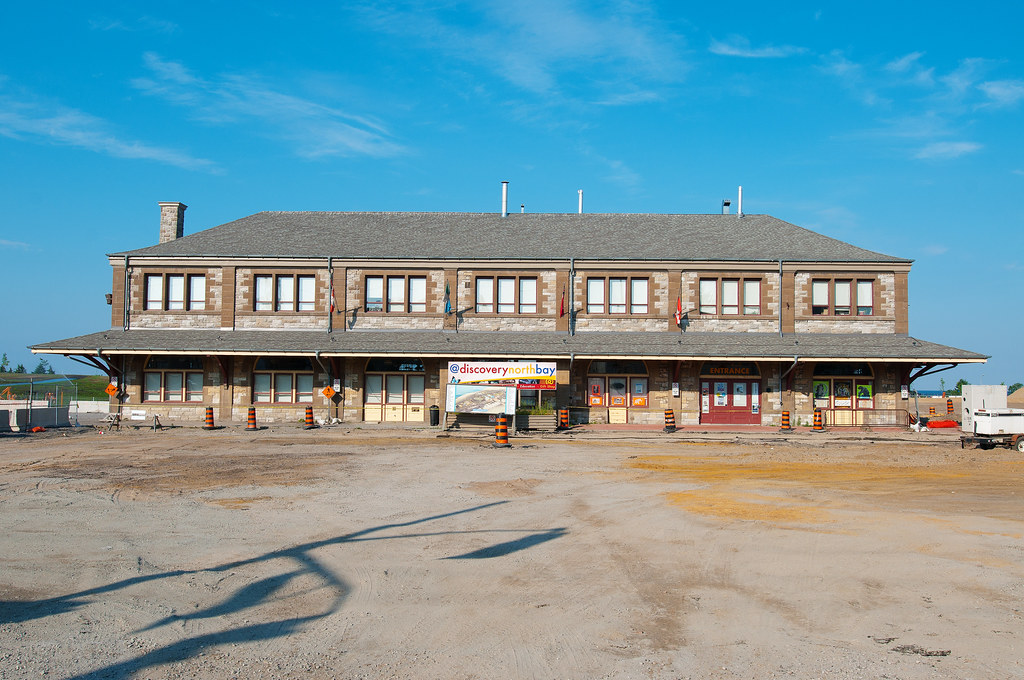
Nikon D300 – AF-S Nikkor 14-24mm 1:2.8G
Nikon D300 – AF-S Nikkor 14-24mm 1:2.8G
Our final destination for the day was only a short drive north of the village of Temagami. We did stop along the way to check out our first ‘big thing’ on the highway, a rather beat-up fish outside Marten River. Our camping spot for the night was at Finlayson Point Provincial Park; our site was pretty terrible for tent camping, but we did manage to get camp set up before heading out. The first exploring point was the former Kanichee Mine. Mining operations had been here since 1910, but most took place between 1933 and 1976, with various operations opening and closing. The mine is located at the end of a narrow, unassumed road. Sadly, between 2010 and 2011, many of the old buildings had been demolished, but not all; the iconic silos were still standing. It was at this point that a major storm swept through the area, and we had to take shelter inside one of the buildings. It passed through quickly. On our way out, the road was blocked, so it took a bit of work to clear the small trees. Thankfully, we had kept some tools in the car, and with a bit of work, we were soon clear.

Kyocera Contax G2 – Carl Zeiss Planar 2/45 T* – Lomography X-Pro 100 @ ASA-100 – Processing By: Silvano’s
Nikon D300 – AF-S Nikkor 14-24mm 1:2.8G
Pentax 645 – SMC Pentax A 645 35mm 1:3.5 – Shanghai GP3 @ ASA-100 – Processing By: Silvano’s
Pentax 645 – SMC Pentax A 645 35mm 1:3.5 – Shanghai GP3 @ ASA-100 – Processing By: Silvano’s
After the storm passed, we took a chance to check out the Temagami Tower. The tower, a 100′ tall former fire watch tower, is now open to the public. It offered up an amazing view of the village and the surrounding area from the top of Caribou Mountain, which stands at 400′, so we were standing about 500′ above the ground and 1300′ above sea level. And the passing storm had left some beautiful sunrays. You can really get an idea of how stunning the landscape up in Northern Ontario is. After taking in the view, we headed back to the village and poked around the old train station (which was still operating at this time), but the yards were empty of any major rail traffic. Then it was back to the campsite, and that’s when we realised how bad the site was, as our tents had collapsed in the storm. Thankfully, we were able to quickly gather our things, fix up the site and settle in for the night. A quick dinner, but no campfire as all the wood was wet. It wasn’t a good night for sleep, but we managed all the same.

Nikon D300 – AF-S Nikkor 14-24mm 1:2.8G
Nikon D300 – AF-S Nikkor 14-24mm 1:2.8G
Nikon D300 – AF-S Nikkor 14-24mm 1:2.8G
Kyocera Contax G2 – Carl Zeiss Planar 2/45 T* – Lomography X-Pro 100 @ ASA-100 – Processing By: Silvano’s
Day Two – Mainly Cobalt
After a rough night, it was back on the road after striking camp, everything was still wet so it was a quick breakfast before continuing north. We did a quick stop in Latchford to photograph the Aubery Cosens bridge and the T&NOR bridge over the Montreal River. Rather than going right to Cobalt we stayed on Highway 11 and went to our campsite to see if we could hang up our tents to let them dry. The site owners were more than happy to let us do this as we were the only clients for the day. From there we went back south, stopping to get a photo of the roadside cow, and hit up Cobalt from the southern side.

Nikon D300 – AF-S Nikkor 14-24mm 1:2.8G
Nikon D300 – AF-S Nikkor 14-24mm 1:2.8G
Nikon D300 – AF-S Nikkor 14-24mm 1:2.8G
Nikon D300 – AF-S Nikkor 14-24mm 1:2.8G
Our first stop for the day, once we got into the town, was the local mining museum. We had arranged for a tour of the Colonial Mine audit. Cobalt is best known for, despite the name, silver. It was the silver rush of the early 20th Century that saw this part of Ontario expand rapidly. Again, being during the week and being this far north, we were the only two people on the tour, but it was still a great way to legally check out an actual mine from almost a century ago. After the tour, we struck out on our own, armed with the Silver Trail map from the museum. It was great to see some familiar spots and check out some new ones. In the new category was the Canmet Refinery, and I don’t have any information about it, so there’s a good chance it’s gone. The real fun was wandering among the many old mine sites across the town. And there is a lot to see; it’s well worth the time to enjoy and sometimes to go off the trail. We climbed through the ruins of mills, checked out leftovers and other remains. The one thing we didn’t spend too much time on was the actual town.

Nikon D300 – AF-S Nikkor 14-24mm 1:2.8G
Nikon D300 – AF-S Nikkor 14-24mm 1:2.8G
Nikon D300 – AF-S Nikkor 14-24mm 1:2.8G
Nikon D300 – AF-S Nikkor 14-24mm 1:2.8G
While it would have been nice to have stopped in a couple of the other towns along Highway 11b, we were in Cobalt a bit longer than expected, so it was a nice scenic drive along 11b to our campsite, which was between Haileybury and New Liskeard, right on the shores of Lake Timiskaming. Our hosts had kindly given us the best site on the property with a scenic lookout onto the lake and a small private island. And far better ground conditions. A bag of charcoal made it much easier to get the fire going, and we enjoyed a far better night as we prepared dinner. Even the owner’s dog came to visit and hang out with us.

Nikon D300 – AF-S Nikkor 14-24mm 1:2.8G
Nikon D300 – AF-S Nikkor 14-24mm 1:2.8G
Nikon D300 – AF DC-Nikkor 105mm 1:2D
Nikon D300 – AF-S Nikkor 14-24mm 1:2.8G
Day Three – Cobalt to Kirkland Lake
After breaking camp we headed north again, along the way we got hit by another summer storm, rather than let that stop us we waited until the rain stopped and made our first driving break in the town of Englehart. Englehart is a town centred around the railroad and in the post-storm made for some dramatic shots. It also helped get us on the right road to make our first attempt of the day, the Adams Mine. We split off from Highway 11 north of Englehart onto Highway 112.

Kyocera Contax G2 – Carl Zeiss Planar 2/45 T* – Lomography X-Pro 100 @ ASA-100 – Processing By: Silvano’s
Nikon D300 – AF-S Nikkor 14-24mm 1:2.8G
Nikon D300 – AF-S Nikkor 14-24mm 1:2.8G
Nikon D300 – AF-S Nikkor 14-24mm 1:2.8G
We did make it successfully to the Adams Mine; however, things were a little more sealed up than the last time I was there. I also noticed signs of recent activity on the property. After wandering around the exterior of the building a bit, it was back on the road. The funny part is while at the mine, my phone rang it was the Henry’s store in Oakville letting me know that the two rolls of Kodak Ektar had arrived which I had ordered specifically for the trip. I had to tell the rep that I was already on the trip and would pick it up the following week. We continued north along Highway 112, a little further east. After joining up with Highway 66 west of Kirkland Lake. From there, we turned east towards the Quebec border. Our stop was the Kerr-Adderson Mine located outside of Virginatown. What was weird about it was how quiet everything was; there were occasional cars or trucks on the road. But for the most part, it was just us. We made no real effort to hide, and the area was quiet; if the locals saw us, they turned the other way. The above-ground features of the mine were limited to only one real building left standing, which was easy to access. Sadly, there was no way to access the workings of the former mine, as the doors to the back were sealed and the fence was impassable. Since we were staying in a hotel overnight, we headed back west towards Kirkland Lake.

Nikon D300 – AF-S Nikkor 14-24mm 1:2.8G
Nikon D300 – AF-S Nikkor 14-24mm 1:2.8G
Nikon D300 – AF-S Nikkor 14-24mm 1:2.8G
Nikon D300 – AF-S Nikkor 14-24mm 1:2.8G
After checking into the hotel, we headed back into the main part of Kirkland Lake to wander around downtown a bit more. The architecture was similar to what we had seen in North Bay. Nothing really too old, mostly from the early to mid-20th Century. This part of Ontario wasn’t settled in any major way until that time, thanks again to the silver and gold rushes of the early 20th Century. What was interesting was the number of surviving vintage steel neon signs scattered around downtown, as well as the similarities and differences between the houses. It felt weird, to be honest, as some were in great condition while others were not. And then we actually got a chance to have real showers and settled in for the night with take-out pizza from a local place, a must on any trip to a different town.

Nikon D300 – AF-S Nikkor 14-24mm 1:2.8G
Nikon D300 – AF-S Nikkor 14-24mm 1:2.8G
Nikon D300 – AF-S Nikkor 14-24mm 1:2.8G
Nikon D300 – AF-S Nikkor 14-24mm 1:2.8G
Day Four – Ramore, Holtyre, & Timmins
It was back to Highway 11 after waking up and grabbing breakfast. We took Highway 66 back to 11 and then turned north. But not before stopping in the small village of Swastika, then it was north, and past the Arctic Watershed, this is the point where water flows north rather than south. Our first stop of the day was one I’ve been waiting to revisit since 2009: CFB Ramore. CFB Ramore served in the Cold War as part of the Pinetree Line and Mid-Canada Line, a series of radar stations designed to detect inbound Soviet nuclear weapons and scramble defenses both interceptor jets or missiles. The site was built by the USAF but would be turned over to the RCAF. Unlike the first time, I knew what I was looking for and where to go, so I kept my speed down and watched for the guard hut. We first spent time in the former domestic area, and there wasn’t much change between 2009 and 2011. Some of the buildings that had been closed were open but were stacked to the rafters with bedframes. Thankfully, there were no demolitions. After a bit of time, we headed up the mountain to the operations area, only to get halfway up. And then you remember that storm, well, it knocked down some far larger trees across the access road. Not having a large enough tool to break it down and not being able to move it by hand, we decided to check how far we had to go. It was too far to drive back down, park, and hike back up. So we decided to push on to the next spot.

Pentax 645 – SMC Pentax A 645 35mm 1:3.5 – Shanghai GP3 @ ASA-100 – Processing By: Silvano’s
Pentax 645 – SMC Pentax A 645 35mm 1:3.5 – Shanghai GP3 @ ASA-100 – Processing By: Silvano’s
Pentax 645 – SMC Pentax A 645 35mm 1:3.5 – Shanghai GP3 @ ASA-100 – Processing By: Silvano’s
Pentax 645 – SMC Pentax A 645 35mm 1:3.5 – Shanghai GP3 @ ASA-100 – Processing By: Silvano’s
Thankfully, it wasn’t too far of a drive from Ramore to our next stop, Holtyre. Holytre is a town that was built on one thing: gold mining. Gold was discovered in 1930 by the Ross family and turned over to Hollinger. It was the Ross Mine that was our target; I had checked it out twice before and was looking forward to seeing it again. Knowing how sleepy the town is, we parked in the town proper near a community centre/church and walked into the mine. Again, if the locals saw us, they didn’t say anything or didn’t see us. Now, I’ll be honest, the main reason for coming this far north was the Ross Mine. And I didn’t shoot much film, despite having a couple of film cameras with me. But it was great to see the place again, and I even got into a couple of other buildings that I hadn’t gotten into before. Sadly, the office building with the document vault had been trashed, and most of the vault had been stripped (which was fine, but meant that James couldn’t pick up anything). After checking out the tailing ponds, we noticed people working on the far side of one of the ponds. Thankfully, we were too far apart to actually be trouble, but we did make for the car just in case.

Nikon D300 – AF-S Nikkor 14-24mm 1:2.8G
Nikon D300 – AF-S Nikkor 14-24mm 1:2.8G
Nikon D300 – AF-S Nikkor 14-24mm 1:2.8G
Nikon D300 – AF-S Nikkor 14-24mm 1:2.8G
We weren’t done with the mines, so we headed a bit further north and turned west along Highway 101. We did stop a couple of times along the way when we saw an interesting subject or headframe. We rolled into Timmins with enough time to spare to catch the second-to-last tour of the 1909 Hollinger Gold Mine in Timmins. Which, at the time, required us to buy the ticket from inside the Shania Twain Centre. We geared up and headed down into the mine. And I have to say the immersion was amazing, full jump suits, wellies, and headlamps and the guide (Claude) was a former miner himself. It was delightfully dark down the mine. Claude would prove knowledgeable about how things were done over the years the mine was active. We got to even ride on a more modern mine train. After the tour, we headed back to the surface and had a chance to wander around the exterior elements before heading into the core and our hotel for the night. Honestly, the tour was worth it, but sadly, it is no longer a thing due to modern exploration and sinkholes. Even in downtown, you could hear the sound of the mines still working.

Nikon D300 – AF-S Nikkor 14-24mm 1:2.8G
Nikon D300 – AF-S Nikkor 14-24mm 1:2.8G
Nikon D300 – AF-S Nikkor 14-24mm 1:2.8G
Nikon D300 – AF-S Nikkor 14-24mm 1:2.8G
Day Five – Mostly Sudbury
After several days of a lot of excitement and adventures, it was time for another day of straight-up driving. Having reached the top of our arc, we were swinging south today. After waking up and grabbing breakfast, we headed out. After a few kilometres on Highway 101, we took a southerly route on Highway 144. There isn’t much along Highway 144; it would take us from Highway 101 to Sudbury. We stopped about halfway on the trip to fill up on gas and give our legs a stretch. Now, in all fairness, there are things along the highway, but often these were either mining or logging towns that were still active. And if there’s one thing about this part of Ontario, it’s that strangers are very much noticed and stand out, especially when the strangers have cameras and are randomly taking photos.

Kyocera Contax G2 – Carl Zeiss Planar 2/45 T* – Lomography X-Pro 100 @ ASA-100 – Processing By: Silvano’s
Nikon D300 – AF-S Nikkor 14-24mm 1:2.8G
Nikon D300 – AF-S Nikkor 14-24mm 1:2.8G
Nikon D300 – AF-S Nikkor 14-24mm 1:2.8G
We made good time to Sudbury. Now there were possible exploration opportunities in the city. I hadn’t gotten any up-to-date access information, so rather than risk being caught or not getting in, we decided to hit up the Big Nickle for some photos before heading to our campsite for the night to get everything set up and going before we lost light. There was a brief talk about checking out the Inco slag pits after dark. But I did see some warnings about increased security in the area, and not wanting to get lost, we enjoyed the quiet sunset and went to sleep.

Nikon D300 – AF-S Nikkor 14-24mm 1:2.8G
Nikon D300 – AF-S Nikkor 14-24mm 1:2.8G
Nikon D300 – AF-S Nikkor 14-24mm 1:2.8G
Nikon D300 – AF-S Nikkor 14-24mm 1:2.8G
Day Six – Manitoulin Island
We slept well despite a few nights in hotels, and the weather was good. The campsite was excellent. After breakfast, we struck camp and got back on the road. Now, the average person would have continued south from Sudbury back to the GTA. But we had no desire to be normal and decided to jump west along Highway 17 before swinging south to Manitoulin Island. We again weren’t planning on doing any real exploring along the way, but our sole purpose was photography. The drive was nice and easy from where we camped, and we made good time. Grabbing lunch once across, we started to explore a bit more. James had some ideas of where he wanted to go, and I had some places I wanted to revisit.

Nikon D300 – AF-S Nikkor 14-24mm 1:2.8G
Nikon D300 – AF-S Nikkor 14-24mm 1:2.8G
Nikon D300 – AF-S Nikkor 14-24mm 1:2.8G
Nikon D300 – AF-S Nikkor 14-24mm 1:2.8G
Our main targets for photography on the island were not the natural beauty but rather the urban environment and the many churches. We checked out the Church Of The Immaculate Conception, a Roman Catholic Parish with a unique, rounded sanctuary and a central altar that not only embraces traditional Roman Catholic iconography but also incorporates elements of Ojibwe culture in the art and styling. Another church we checked out was St. Paul United on the Hill, an 1881 Methodist Church (United since 1929) in Kagawong and is the oldest building left standing in the community. What’s unique is that the pulpit is built from wood salvaged from wooden ships. We did make one stop at Bridal Veil Falls before heading into Wikwemikong. What makes Wikwemikong unique is that it’s the largest unceded territory in Canada under the full control of the Ojibwe people. We stopped briefly near the ruins of the Jesuit Boys and Girls School, which burned and was one of the many Day Schools operated by the Roman Catholic Church. After checking it out, we headed to our camping spot, the South Baymouth Resort and even got a bit of an upgrade to a cabin for our final night.

Nikon D300 – AF-S Nikkor 14-24mm 1:2.8G
Nikon D300 – AF-S Nikkor 14-24mm 1:2.8G
Nikon D300 – AF-S Nikkor 14-24mm 1:2.8G
Nikon D300 – AF-S Nikkor 14-24mm 1:2.8G
Our final day on the road saw us wake up, pack up and head to the ferry docks. I had booked passage on the MS Chi-Cheemaun to ferry ourselves and the car back to the mainland. The ride was smooth, and I did get some photos on the way using my Pentax 645. From there, we continued south using Highway 6. I ended up getting a speeding ticket outside of Owen Sound. But it was another long drive home. It was an amazing trip, and I’m glad I took it. I saw some amazing places in the province. It also made me realise how big and diverse Ontario is. Southern Ontario is totally different from the northern parts of the province, and the scale and distance are thrown out of the window compared to what we experience here in the south. Plus, there is the entire weight of history that we never learn about in the average reading of Canadian and Ontario history. Would I do such a trip again? In a heartbeat, but I would do a few things differently, and one of them would be longer drives and more hotels. You can check out all my photos over on Flickr, also make sure to check out James’ images over on his account.