I had not been exploring in Buffalo proper since 2007, and honestly, if they had including some of these locations at that event I probably would have had a better time. So taking advantage of the invitation to join in a short Labour Day exploration in 2012 to check out a couple of locations on the other side of the border, I jumped on the chance. Both locations we checked out were right next to each other in a former industrial corridor on Northland Avenue. Of the two, the most interesting is this spot, the former Curtiss-Wright metal forming works, but its history is much more interesting than I originally thought.

Nikon D300 – AF-S Nikkor 14-24mm 1:2.8G
The Otis Elevator Company, founded in 1852 in Yonkers, New York first demonstrated the safety elevator system at the 1853 World’s Fair. The device was a near instant success and Otis quickly expanded even through the American Civil War. In the early 20th Century they aimed to further expand their manufacturing base and took a look at Buffalo, New York. The recently completed New York Central Railroad Belt Line opened up new industrial land along Northland Avenue. Otis purchased a parcel of land at Grinder and Northland in 1906 and constructed a brand new manufacturing facility to produce their plunger-type elevator opening the complex in 1906. With the advent of powered flight several new areoplane manufacturing businesses opened up across the United States starting in 1909, the Wright Brothers started the Wright Company in Dayton, Ohio while the Curtiss Aeroplane & Motor Company opened in Hammondsport, New York. Glen L. Martin would form the Glen L. Martin Company in 1912. Requiring additional foundry space, Otis completed a new foundry in 1913 to round out their booming Buffalo Works. In 1916, Wright and Martin merged to form the Wright-Martin Company, but when the merger didn’t go so well, Glen spun off his old name in 1917 and the Wright Aeronautical Company came out in 1919. By 1926, Wright and Curtiss had a far more successful merger opening the new headquarters for Curtiss-Wright in Buffalo, New York. Otis would expand their Buffalo Works in 1939 and then in 1942. Both Otis and Curtiss-Wright put their respective industrial know-how to use to support the American war effort, Otis in Buffalo produce elevators for US Navy Aircraft Carriers, steel castings for Anti-Aircraft guns, turret rings and other aircraft gun mounts, and other materials. Curtiss-Wright produced the P-40 Warhawk, a noted ground-attack aircraft and among the first flown by the famous Tuskegee Airmen better known as “Red Tails.” At some point in the post-war period, Otis would spin off operations in the Buffalo works into a seperate company but the complex would be purchased by Curtiss-Wright in 1951. Curtiss-Wright would use the facilty for the metal forming division upgrading the old equipment and reopening the complex in 1955. The site could produce heavy metal tubing using either uranium or chromium-molybdenum heavy walled steel tubes, steel propellers and later titanium components for jet engines. Curtiss-Wright would complete a 3.5 million dollar expansion in 1968 as the Cold War fueled the need for better aircraft. Production continued to roll out from the Buffalo works until 1993, with the end of the Cold War and contraction in the civilian market, the Buffalo works closed their doors that same year. In 1995 the entire complex was bought out but no redevelopment was completed, the newer section would be purchased and converted into a laundry facility for Sodex in 2006. The reminder of the site remanded empty but would hit the news in 2012 with the Buffalo Billions announcement which aimed to redevelop the Northland industrial coridor. State funding secured in 2014 allowed the Buffalo Urban Development Corporation (BUDC) to purchase the remaining complex. But by this point age and time had taken their toll and many of the buildings were beyond salvage, only a single building at 741 Northland was identified as a possible spot for redevelopment, but the 1913 foundry at 777 Northland was in far worse shape and despite efforts to add a historic designation in 2017 all signs point to a future demoltion. Although according to Google Streetview the building was still standing in 2020

Nikon D300 – AF-S Nikkor 14-24mm 1:2.8G
Nikon D300 – AF-S Nikkor 14-24mm 1:2.8G
Nikon D300 – AF-S Nikkor 14-24mm 1:2.8G
Nikon D300 – AF-S Nikkor 14-24mm 1:2.8G
Nikon D300 – AF-S Nikkor 14-24mm 1:2.8G
Cross-border exploration trips are always hit-or-miss; thankfully, I was joined by several friends on the journey and, most importantly, trusted friends. I had not been exploring Buffalo since OPEX ’77. That event left a bit of a bad taste due to several unsavoury events. But the day went on. The Labour Day Weekend was bright, sunny, and promised to be a good day. The real trick is what to tell the border agents. Either way, the crossing went without a hitch. Being a long weekend and being in an industrial area, our cars were the only ones around. The area was filled with a tonne of old industry from the early 20th century, but we had two locations to choose from. Parking our cars halfway between our two targets in a business lot, the former Curtiss-Wright plant was our first stop. It was a quick duck through the fence and into the 1913 building. While small, it had a big empty calling. Looking back at the photos and the Google Maps view, I missed the entire building next to the 1913 building. I don’t know if it was a mistake on my part that it was not accessible through the building we were in. Is it a bit of both, or that there was work in progress at the building? Either way, there was lots to see; the highlight was the 12,000-ton, 126-foot horizontal press built by the Loewy-Hydropress Division of Baldwin-Lima-Hamilton. I had seen some massive machines in these abandoned factories before (Don Valley Brickworks and Flintkote), but this was massive. I mostly stayed in the main area of the building, and after a while, we headed out to the second location.

Nikon D300 – AF-S Nikkor 14-24mm 1:2.8G
Nikon D300 – AF-S Nikkor 14-24mm 1:2.8G
Nikon D300 – AF-S Nikkor 14-24mm 1:2.8G
Nikon D300 – AF-S Nikkor 14-24mm 1:2.8G
Nikon D300 – AF-S Nikkor 14-24mm 1:2.8G
Single-trip visits show little photographic growth, but that’s alright. This marked the first time I took the film into an abandoned location and developed it myself. The compositions here are clean and straight, lealeanwards more flat images and leading lines. But I also changed it with some shots from an angle. I even included a nice portrait of one of the companions on the trip. Despite having an ultra-wide lens, I used the fast aperture and narrow depth of field to isolate my subject. The only thing I wish is that I had lowered myself so as not to cut off her feet! But the one thing I am happy about is how well the medium format film shots turned out; of course, the classic Tri-X developed in Kodak HC-110 stand out and the use of the 35mm lens on the Pentax 645. These show why I kept using black & white more in abandoned buildings than colour film moving forward. While I only managed twenty-two images from this trip, I was starting to think more, shoot less. The result being less images to sort through, but having a greater percentage of keepers.

Pentax 645 – SMC Pentax A 645 35mm 1:3.5 – Kodak Tri-X 400 @ ASA-400 – Kodak HC-110 (B) 7:30 @ 20C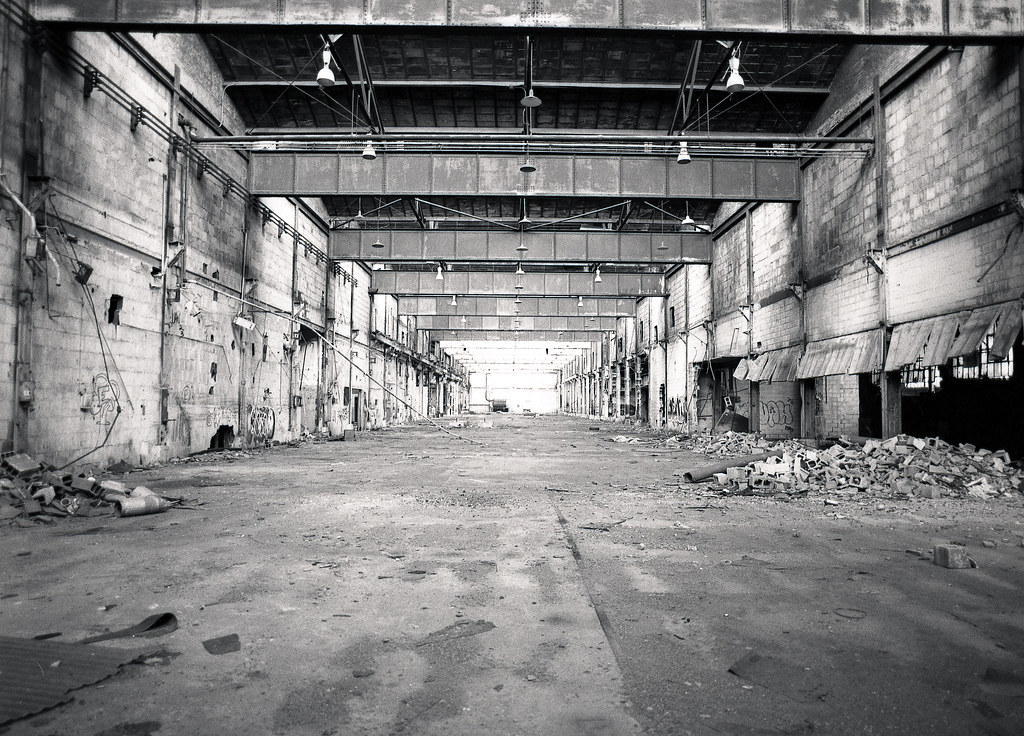
Pentax 645 – SMC Pentax A 645 35mm 1:3.5 – Kodak Tri-X 400 @ ASA-400 – Kodak HC-110 (B) 7:30 @ 20C
Pentax 645 – SMC Pentax A 645 35mm 1:3.5 – Kodak Tri-X 400 @ ASA-400 – Kodak HC-110 (B) 7:30 @ 20C
Pentax 645 – SMC Pentax A 645 35mm 1:3.5 – Kodak Tri-X 400 @ ASA-400 – Kodak HC-110 (B) 7:30 @ 20C
Pentax 645 – SMC Pentax A 645 35mm 1:3.5 – Kodak Tri-X 400 @ ASA-400 – Kodak HC-110 (B) 7:30 @ 20C
I never went back to Buffalo to explore after this trip. I don’t know why, but I wish I had gone back here again and tried to get into that second building on-site, looking at it in hindsight. While the future could look better for this location, I hope the city pushes forward and continues to revitalize and bring back this part of the city to attract new businesses and jobs. But I can’t find any new information about the process. But at least the building is still standing, at least for now. You can check out all the images on Flickr.
Glossary of Terms
Plunger-Type Elevator: A plunger elevator is a hydraulic elevator that uses a steel plunger, counterweight, and water pressure to move the elevator car.
Curtiss-Wright P-40 Warhawk: The Curtiss P-40 Warhawk is an American single-engine, single-seat, all-metal fighter-bomber that first flew in 1938. The Warhawk was used by most Allied powers during World War II, and remained in frontline service until the end of the war. It was the third most-produced American fighter of World War II.
Tuskegee Airmen: The Tuskegee Airmen was a group of primarily African American military pilots and airmen who fought in World War II. They formed the 332nd Fighter Group and the 477th Bombardment Group of the United States Army Air Forces (USAAF). The name also applies to the navigators, bombardiers, mechanics, instructors, crew chiefs, nurses, cooks, and other support personnel. The Tuskegee airmen received praise for their excellent combat record earned while protecting American bombers from enemy fighters. The group was awarded three Distinguished Unit Citations.
Chromium Molybdenum Steel:Chromium-molybdenum alloy steel, is an alloy used for high pressure and temperature use. It is used in oil and gas, energy, construction and the automotive industries because of its corrosion resistance and high-temperature and tensile strength.
Titanium: Titanium is a chemical element; it has symbol Ti and atomic number 22. Found in nature only as an oxide, it can be reduced to produce a lustrous transition metal with a silver color, low density, and high strength, resistant to corrosion in sea water, aqua regia, and chlorine.
Cold War: The Cold War was a period of global geopolitical tension and struggle for ideological and economic influence between the United States and the Soviet Union (USSR) and their respective allies, the Western Bloc and the Eastern Bloc, that started in 1947, two years after the end of World War II, and lasted until the fall of the Soviet Union in 1991.
Buffalo Urban Development Corporation: BUDC seeks to create an environment conducive to private investment, provide oversight and visioning for projects of regional significance, serve as a liaison among various public and private stakeholders, serve as a conduit for public funding of significant projects and serve as a real estate holding company for certain public-sector projects.