My introduction to photography came in the early days of digital photography entering the mainstream, so my medium of choice had always been film. You could pick up decent film cameras for cheap while digital cameras were still the realm of professionals or the rich. And the early options were low-quality. I had used digital through high school and my first years of college; my high school had the early Apple digital camera and also the Sony Mavica (the one that took 3.5″ floppy disks). And my dad had won an early HP digital camera through work. But I realised it was only a matter of time before digital would have to come into my workflow, especially when I started working full-time and earned some adult money. While the early digital SLRs remained out of my price range (there was no such thing as a consumer digital SLR), a bridge camera made perfect sense, and of course, it had to be a Minolta, the DiMAGE Z2.
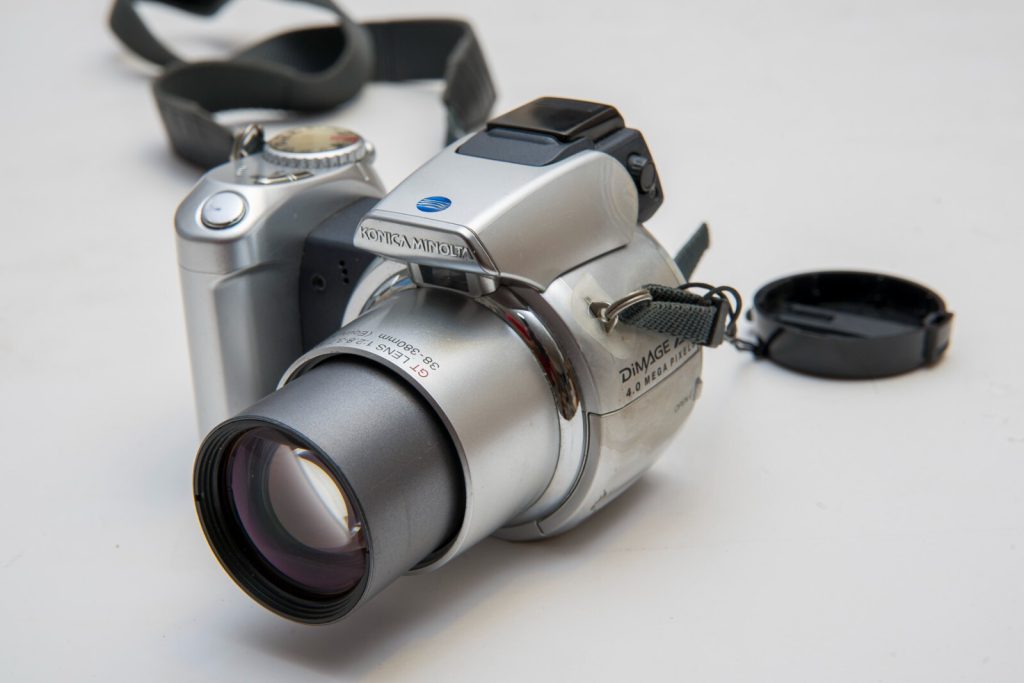
Ever since I started working out of Oakville and expanded my film choices beyond colour negative films, I had been going to Oakville’s old Henry’s store, the one located at Speers and the QEW. They sent the films to Silvano’s, a since-closed professional lab in Toronto, for development. Henry’s is a Canadian photography store chain and was my first experience with the joys of used gear and different film stocks, including professional colour negative, traditional black & white, and slide film. Henry’s also hosted a big photography trade show every year and often handed out free tickets and coupons to regular customers. In addition to vendors, demos, the show was also a great spot to pick up deals on used gear, returned gear, and open-box demo specials. The show was the perfect place to shop, so in late fall 2005, I headed there with an eye for a digital camera. One of the people running the tables was the same representative that I dealt with the most at the Oakville store, and he proved super handy and guided me through the options. Bridge cameras seemed to be the best choice between my film cameras and digital options without dealing with jumping to an SLR, and of course, it had to be Minolta, or Konica-Minolta as they were now known. And eventually settled on the DiMAGE Z2, a great blend between a cheaper consumer and a more expensive high-end option. Now, Bridge Cameras, or Super-Zoom, were all-in-one units that offered a wide-to-telephoto lens with plenty of other features, including different operation modes, picture modes, and shutter sounds. It was a great choice and a really good deal, with only one cable missing to connect a VCR or TV, something I had no desire to do.


The Z2 was exactly what I needed at the time, and it soon became my primary camera. The day I got the camera, I grabbed batteries and used the SD card provided in the box, and checked out a set of abandoned houses at the intersection of Dixie and Derry. Having a digital meant I could also go out and practice photography whenever I felt like it, without being tied to an entire roll of film. Even back then, I disliked leaving rolls of film in cameras. The Z2 provided me with the freedom to experiment and try new things. It came along to that year’s PYPS leadership retreat, and I took a photo that would eventually be published on the cover of a national magazine. It also became a companion of my earliest exploration adventures, including my first trips to Hearn, Muskoka Regional Centre, Firestone, and Lister Block. Four spots that saw a great deal of exploration and became favourite spots of mine.


The Z2 brought the digital age in, and in the grand scheme of things, this was only three years after I first started seriously picking up photography. While I learned a lot with my film cameras, the Z2 offered up instant results on the screen. I learned about manual metering and how to read a scene rather than relying solely on the in-camera meter. How not to use in-camera picture effects, despite the fact that I got some great photos using them. It’s far easier to shoot in colour in the camera and then adjust them in post without losing that original. I learned about direct flash, long exposure, night photography, and even light painting. All things that were much harder and costlier on film. Photos from the Z2 were the earliest I had published in a national magazine, including one on the cover. It proved to me that a good photo was a good photo and that the medium didn’t matter. I also learned how to edit, meaning picking the best from the batch and sharing only those, rather than dumping everything. And in addition to that, learning when to press the shutter and when not to, because it’s so easy to spray and pray. It would be a lesson that I had to learn again with my first digital SLR. But the biggest lesson was learning where to safely put down your camera; the Z2 ultimately paid for that and took a tumble off a roof at the former Edgar Adult Occupational Centre. Which sucked, because that night I took my one and only trip to the former Lakeview Generating Station and never got to go back, so I have no photos from that trip.


Today, the Z2 would be sought after, not as much as more compact options from the era, but as a 4-megapixel CCD-sensor camera that produces the ‘digi-cam’ look some photographers seek. But when I was using it, I didn’t think too much of it because, well, that’s what most people had. The Z2 is easy to operate; I didn’t have to read many manuals to get the most out of it. Operations were intuitive, and the menus were well laid out. The lens was decent at the wide-angle end, but it faced some optical issues when zoomed all the way in, which is pretty common in this type of camera (both in film and digital). The biggest issue with the camera (and all cameras of the era) was low-light performance. You didn’t have many issues at lower ISOs, but once you started cranking it up, you got annoying digital noise, which was equally hard to remove in the era’s post-processing. The EVF was decent, given the era; the screen was good; autofocus and exposure were good; and there were four (PSAM) shooting modes that made it far more useful than all-automatic cameras. It also only took 4 AA batteries to power it, plus it felt good in the hand. A more gimmicky feature is the ability to add faux-shutter noise. You had the choice between the Minolta CLE or the Maxxum 7. I flipped between the two, but my favourite was always the Maxxum 7.


The Z2 lasted only a year in my kit before the accident damaged the camera beyond repair. I ended up replacing it with another bridge camera, the Panasonic Lumix FZ-7, a bit of an upgrade but probably a mistake, as by that point I was already building a Nikon F-Mount lens kit and should have jumped right to an SLR. But the FZ-7 cushioned the blow and actually proved to be a good camera for the short time it was in my kit. The Z2 worked, it was the right camera for the time when I got it, a nice in-between of going from film cameras into the digital sphere. I regret the accident that wrecked the camera, and I’m sure that if that hadn’t happened, the Z2 would have held on for that little bit longer before joining the Nikon digital ecosystem.