I almost did not post this entry. It was my only trip when I visited the historic campus in 2015. The entire site clearly presented itself as abandoned. People were working up near the front of the campus, but mostly they ignored us, and we ignored them. But here’s the rub: the place was not abandoned or technically even closed, although most buildings had been shuttered since 1997. And while the place is currently active, at least partly, there’s still that sinking feeling that bringing these images out in a new way could harm the college. But I occupy such a small corner of the Internet, what could happen? Knoxville College has a rich history far richer than I initially thought. I would love to tell these stories.

Sony a6000 + Sony E PZ 16-50mm 1:3.5-5.6 OSS
Racism is an ugly word and an even uglier practice. Still, it is the systemic racism within the United States where this story starts. Many blacks within the United States struggled to receive proper education no matter their status (both enslaved and free). But many within the abolitionist movement, even in the slave-owning states, made efforts to provide education to blacks. Most of the work was done by churches and individuals who were part of the abolitionist movement, among them R.J. Cresswell of the United Presbyterian Church (today a part of the Presbyterian Church USA), who opened the first school in Knoxville, Tennessee, in 1864. Creswell’s school operated out of the First Baptist Church (At this time located on Gay Street; the congregation still exists today in their current and third building at 510 Main Ave). As the numbers grew, the school purchased land and constructed a dedicated building in East Knoxville in 1866. Despite apathy from the local government and threats from the city’s white population, enrollment in the school grew. By the 1870s, the school was on a trajectory to outgrow its building in East Knoxville and began to seek out a larger property, settling on one in Mechanicsville, a historically black neighbourhood. The site was purchased up on a hill and ironically housed a Confederate artillery battery during the American Civil War in 1875. Knoxville College began constructing the new main building. The main building, named McKee Hall, opened in December 1876, and the first students began arriving. Knoxville College provides education at the primary and secondary levels. It also acted as a normal school for training new teachers and, by 1877, began to offer college-level classes. As the college grew, new buildings were added with a President’s House in the 1880s and Wallace and Elnathan Hall in the 1890s, providing space for an Orphanage (Wallace) and additional classroom space (Elnathan). The school offered agriculture, industrial arts, programs and even medical education. At the end of the Century, the school suffered two major fires; one destroyed Elnathan Hall, which was rebuilt, and the second significantly damaged McKee Hall, which saw massive reconstruction. By the turn of the Century, Knoxville College spun off its medical school into a separate school, Knoxville Medical College (which operated until 1910 before being absorbed into Lincoln Memorial University) and received state accreditation. The students were also allowed to offset tuition costs by working for the college; brickworks supplied materials for building projects on campus and around Knoxville, and several buildings were added to the campus throughout the first few decades of the 20th Century. Students also aided in designing and constructing faculty cottages, residences and academic buildings, along with the 1913 McMillian Memorial Chapel. The college also integrated itself into the community, defending the black community during the 1919 race riots and funding a hospital dedicated to the health of the black community, which also played a key role in the Influenza pandemic (Spanish Flu (1918-1920)). After a series of on-campus protests, the campus relaxed its strict code of conduct in 1931. It allowed the formation of a student government and council.

Sony a6000 + Sony E PZ 16-50mm 1:3.5-5.6 OSS
Sony a6000 + Sony E PZ 16-50mm 1:3.5-5.6 OSS
Sony a6000 + Sony E PZ 16-50mm 1:3.5-5.6 OSS
Sony a6000 + Sony E PZ 16-50mm 1:3.5-5.6 OSS
Sony a6000 + Sony E PZ 16-50mm 1:3.5-5.6 OSS
In 1957, Knoxville College received full accreditation from the Southern Association of Colleges and Schools, becoming the first all-black college to receive the nod from the body. The students continued to protest segregation in the city. They protested to remove the practice from the city’s lunch counters. The college would also update its charter in 1962 to allow white students to enrol. However, as education opportunities began to expand for black students outside of the historically black schools, Knoxville started to see a decline in student enrollment. The drop in enrollment saw a drop in income, which put the college on shaky financial grounds. Knoxville continued to struggle through the 1970s and 1980s. While the original campus building set was designated a historical district in the 1980s, it did little to help the college’s profile. Things came to a head in 1997; the loss of accreditation by the SACS tanked enrollment and forced the college to start cutting programs and closing buildings. The school could no longer pay their employees and bills, and the school struggled along. By 2005, the Board of Trustees fired the President, and the Alumni Association began a fervent fundraising campaign. There were some attempts at a revival, but things ground to a crawl. It didn’t help that in 2014, the Sciences building was seized by the Environmental Protection Agency for misstorage of toxic chemicals (there were even rumours that radioactive material was stored improperly). The state provided a multi-million dollar loan to help with the cleanup; a year later, the student body numbered eleven and a skeleton staff of mostly volunteers. The city began issuing warnings that the college must begin repairs to their shuttered buildings as arson had become a serious concern and threatened total condemnation of every building on the campus. It was enough to start the process of slowly repairing the campus. To speed up the process, the college moved to a strictly online model for delivering materials in 2017 and, a year later, was able to move staff back to a small annexe building attached to McMillan Chapel. While Knoxville College continues to work under an online delivery model, it hopes to keep restoring some of its historic buildings, focusing most of its work on the McMillan Chapel and Alumni Library. By 2023, the college began work to regain accreditation from a new body, Transnational Christian Colleges & Schools. However, in 2024, fire destroyed the historic Elnathan Hall again. 2025 also marked the 150th Anniversary of the College, which has a solid student body again. However, they still cannot operate in-person classes on the historic campus.

Sony a6000 + Sony E PZ 16-50mm 1:3.5-5.6 OSS
Sony a6000 + Sony E PZ 16-50mm 1:3.5-5.6 OSS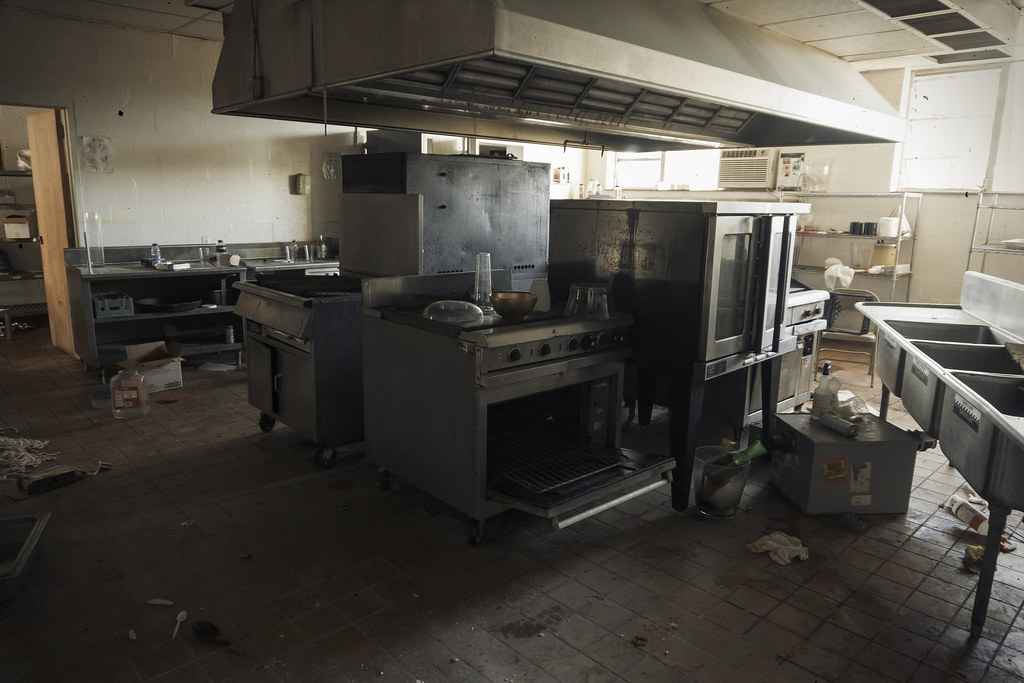
Sony a6000 + Sony E PZ 16-50mm 1:3.5-5.6 OSS
Sony a6000 + Sony E PZ 16-50mm 1:3.5-5.6 OSS
Sony a6000 + Sony E PZ 16-50mm 1:3.5-5.6 OSS
Honestly, I’m surprised that we got away with this one for two reasons; the first is that it had been only a year since the EPA raided the science building, and the second is because the campus and college were technically not abandoned or closed. As an added bonus, there was active construction on the campus, and I’m sure they spotted us at one point, but here we are. Approaching the campus from the back was the easiest way and a good way to hide our cars in various parking spots to avoid attention. We knew we were on a short timeline as we had spent the morning at Brushy Mountain, but Knoxville was en route back to Asheville and made for a good stop. The whole place looked as if it had been lifted from the Fallout universe; the massive empty dorm buildings loomed over us as we walked through the tall grass. I learned about the local drama about the place, especially the rumours of how the EPA raid happened on the science building, so of course, that was our first stop. Despite being sealed to protect the chemicals inside, access proved stupidly easy, but when there’s a will (and a climber), there’s a way. And if that was the only building we got into, it would have been worth it; the place was packed. Classrooms are filled with equipment, books, chemicals, computers, and other things. Afterwards, we headed out for the student life building, which also proved fascinating for the big empty spaces. The main cafeteria has some great light, and there were still a few interesting items floating around; there used to be a photo of me floating around Facebook holding an American flag in an epic pose. I tried to find it, but the person deactivated their account. From there, we headed out for the theatre building; I didn’t get too many photos in there as I was too busy looking at the old gear and found a pile of slides (Kodachrome). The last spot we visited was the gym, which proved dull. After that, we wandered around the front of the campus and saw people working on the memorial chapel and alums library, which is understandable given that those are the spaces used today by the limited staff for Knoxville College. Not wanting to try our luck, we returned to our cars from the front of the campus rather than returning the way we came. Just in case someone had seen us.

Sony a6000 + Sony E PZ 16-50mm 1:3.5-5.6 OSS
Sony a6000 + Sony E PZ 16-50mm 1:3.5-5.6 OSS
Sony a6000 + Sony E PZ 16-50mm 1:3.5-5.6 OSS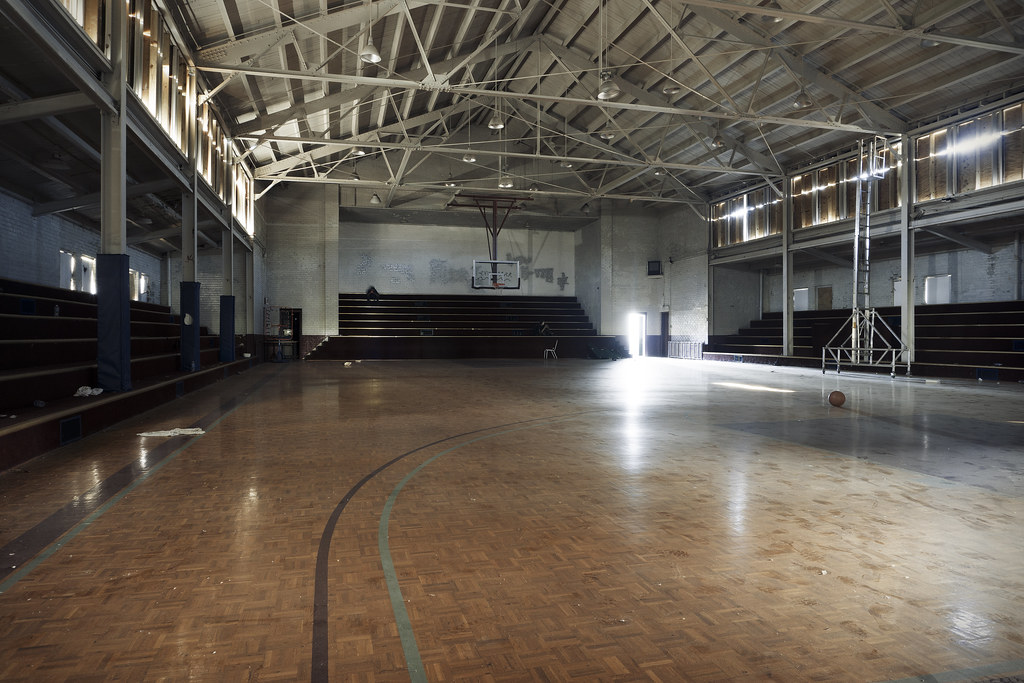
Sony a6000 + Sony E PZ 16-50mm 1:3.5-5.6 OSS
Sony a6000 + Sony E PZ 16-50mm 1:3.5-5.6 OSS
The first thing you will find with these images is a consistent look for all the digital and film images. The film shots helped inspire how I edited the digital shots. As I mentioned, while exploring this place, I was reminded of the Fallout series of RPG video games, specifically Fallout 3, which I was playing heavily. With all the stuff left over, I wanted to get a similar look to these. So, in selecting FPP Retrochrome 320 as the film stock of choice, Eastman Ektachrome 2253 is a film used to record nuclear tests. The way it expired gave a warm, contrasty look close to what you see in Fallout 3. Then I used a film simulator and the Kodachrome II preset with a bit of ageing added to it to give a similar look. These photos are the only time I have done this where I consistently looked at my images across every single one. All my digital photos are hand-held with my Sony a6000; this was part of my first time using my a6000 while exploring, having picked it up earlier in 2015 for my Europe trip. I am happy about these photos; they show off a lot of campuses where the more interesting things are, such as student life building. Interestingly, there isn’t much from the audio/video building. But I was too busy looking at all the slides scattered around. One thing to note is that there were two types of slides, Kodachrome and Ektachrome, and despite the building being wide-open, the Kodachrome slides looked perfect. In contrast, Ektachrome looked like a dog’s breakfast.

Nikon F5 – AF-S Nikkor 14-24mm 1:2.8G – FPP Retrochrome 320 @ ASA-320 – Unicolor Rapid E-6 Kit
Nikon F5 – AF-S Nikkor 14-24mm 1:2.8G – FPP Retrochrome 320 @ ASA-320 – Unicolor Rapid E-6 Kit
Nikon F5 – AF-S Nikkor 14-24mm 1:2.8G – FPP Retrochrome 320 @ ASA-320 – Unicolor Rapid E-6 Kit
Nikon F5 – AF-S Nikkor 14-24mm 1:2.8G – FPP Retrochrome 320 @ ASA-320 – Unicolor Rapid E-6 Kit
Nikon F5 – AF-S Nikkor 14-24mm 1:2.8G – FPP Retrochrome 320 @ ASA-320 – Unicolor Rapid E-6 Kit
I feel bad for this institution; it had everything going for it until the bottom fell out from under it. While the school continued, it was moved into being a shadow of its former self, forced to hide in a small single building on a once glowing campus with a tonne of history behind it. And now it can’t even hold classes in person, one of its historic buildings is no longer there, and another one probably won’t be saved. The future is dim for Knoxville, and I hope that something can be done and some level of in-person learning can occur again. You can check out all my photos here on Flickr.