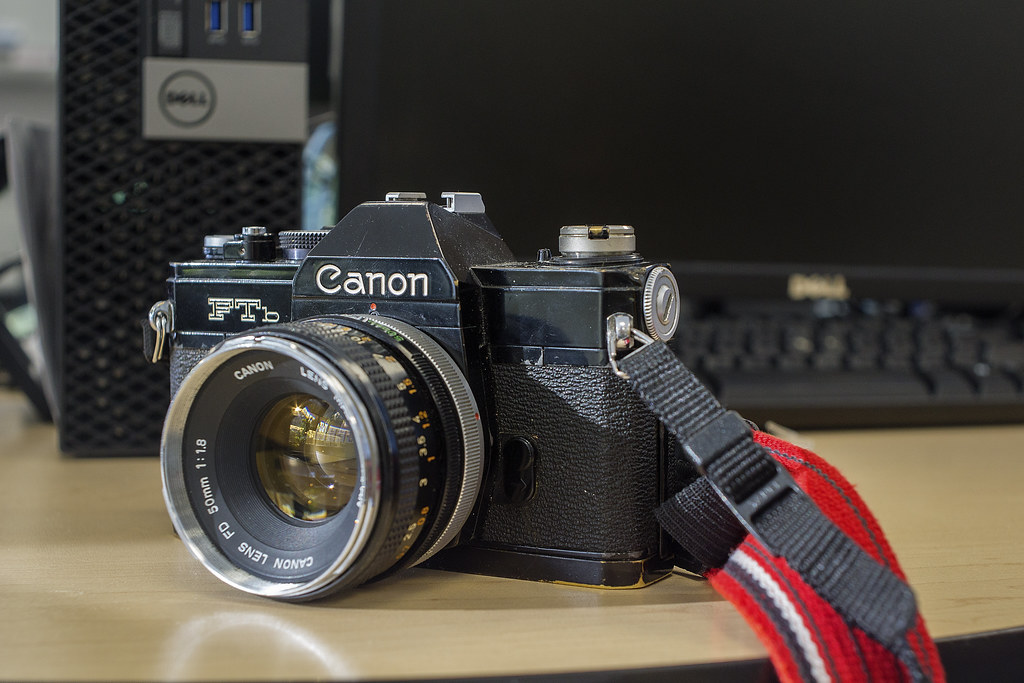
While I have shot only a handful of Canon products during my reviews, they’ve all given positive results in my books. The Canon FTb is not bucking this trend as a solid match needle, mechanical SLR it is certainly a top pick for me as a student camera. Simple in its operation, and yet provides a good solid introduction to 35mm film photography. Special thanks to Bill Smith for loaning out this black beauty!
Disclaimer: This is an old review, and is scheduled for an update and may look funny during that update. However, due to a large number of reviews that require this update it may take some time. Please be patient during this process as the reviews may appear incomplete and in flux during the update procedure.
Camera Specifications
Manufacturer: Canon
Model: FTb
Type: Single Lens Reflex
Format: 135 (35mm), 24x36mm
Lens: Interchangeable, Canon FD-Mount
Shutter: Cloth Horizontal travel focal plane shutter, 1s-1/1000s + bulb
Meter: Centre Weighted CdS TTL Metering, EV2.5 ~ EV18 @ ASA-100, ASA-25 – ASA-2000
Dimensions (WxHxD): 144x93x43mm
Weight: 750g (w/o lens or battery)
Power Source: 1x PX625
Year of Manufacture: 1971-7
Background
Canon traces its origins to 1933, when a group of men decided to build a high-quality Japanese copy of the Leica II. After acquiring, disassembling, and studying the Leica II, the Precision Optical Instruments Laboratory introduced its first prototype in 1934. This would be refined, and manufacturing at scale would start in the late 1930s. These first cameras used the M39 mount, and lenses were supplied by Nikon. The name Canon was adopted in 1947, and in 1951, Canon began producing lenses in-house. While rangefinders remained their primary camera type, the rise in popularity of SLRs saw Canon release the Canonflex in 1959. The Canonflex centred on the bayonet R-Mount; these were system cameras with an instant-return mirror. In 1960, the R2000 replaced the original Canonflex with some updates, including a top shutter speed of 1/2000s. Canon would update its lens mount in 1964 with the release of the new FL-Mount, which was physically similar to the older R-Mount but changed the aperture linkage. With the new lens mount, Canon released two new SLRs, the FX, which featured an external coupled meter, and the FP, which was the same as the FX but lacked a meter. The Canon FT hit the market in 1966; it featured a TTL meter, but due to the limitations of the FL-Mount, it relied on stopped-down metering. To fix this problem, Canon introduced the FD-Mount in 1971. Along with the professional system camera, the F-1, Canon introduced a new version of the FT, the FTb. The FTb was basically the same as the original FT but used the new FD-Mount, allowing TTL metering to exploit the open-aperture functions of the new lens mount. Canon offered four packages, for just an FTb body it cost ¥35,000 (900 CAD in 2026), with a 50mm f/1.8 Lens the cost was 49,800¥ (1,280 CAD), with a 50mm f/1.4 lens the cost was ¥57,000 (1,465 CAD), and at the top with a 55mm f/1.2 lens the cost was ¥74,000 (1,902 CAD). Canon completed a minor update to the FTb in 1973; unofficially, users refer to it as the FTbn, but Canon never made that official. The difference between the two versions is mostly cosmetic. There was a change in the placement of the shutter speed dial, F-1-style displays, F-1-style self-timer, and a spring lock on the PC socket to prevent accidental electric shock. When Canon ceased production in 1977, approximately 1.8 million FTbs had been produced.


The Good
The number one thing I love about this camera is the Quick Load function. Often with older cameras it takes a bit of fiddling to get the film loaded up, some cameras are easier than others, and then there’s the Canon Quick Load. It seriously makes it easy like my Nikon F5, lay down the film, close the door, advance fire, advance, fire and you’re ready to rock and roll. Everything else is fairly well laid out and in a normal place. A power switch to save on battery power, a short throw on the film advance and a pleasing weight in hand. And finally, it’s a match needle metering system very similar to my first SLR, the Minolta SRT-102, put the hole over the needle, nice and easy!


The Bad
By this point, reader, you will probably realize that there are some cameras that I try hard to find a fault in, and I normally will go for something petty, well the FTb is one such camera. And that fault is, of course, the battery. The camera does need a mercury cell to work, a power source that isn’t exactly easy to find these days. Now there are some alternatives such as an adapter to step down the power out of a current battery or an air-zinc battery. Then again as the FTb is a mechanical camera all the battery powers is the internal meter, so it isn’t that big of a deal.


The Lowdown
If you don’t want to spend a fortune to get a solid learner camera, then the FTb is certainly for you. With or without a working meter you get the most bang for your buck, and both the camera bodies and lenses are plentiful online and in reputable used camera shops. If I didn’t already have an extensive selection of Nikon cameras and lenses, an FTb would certainly be a welcome addition to my camera bag. So if you don’t like the idea of grabbing a cliche K1000 or FM, then give the FTb another look, it won’t let you down.
Video Review Coming Soon.
Further Reading
Don’t just take my word on the Canon FTb; you can check out the reviews by other awesome camera reviewers!
Aly’s Vintage Camera Alley – Canon FTb QL Review
Ken Rockwell – Canon FTb Review
Greg Pak – A Love Letter and Guide to the Canon FTb: The Best First Film Camera Ever?
High 5 Cameras: Canon FTb Review
The Noisy Shutter – Classic Camera Review: Canon FTb QL
Sam Mallery – The Canon FTb SLR: My New Camera (From 1971)
2 Comments