We’re picking up where we left off last month with the second of two locations we hit up on a quick Labour Day trip to Buffalo in 2012. If you aren’t part of the classic hot rod hobby, the name Houdaille might be lost on you, but even today, these styles of shocks are highly valued in the hobby, especially when restoring or rebuilding cars from the 1930s and 1940s. The location itself didn’t spark anything interesting because it was empty. Its real value is in the history.

In March 1909, French inventor Maurice Houdialle filed a patent for a new style of shock absorber for automobiles. The Houdialle unit used a leaver style as opposed to a piston-style shock absorber, and these quickly gained popularity in Europe. In 1915, Paul Clodio acquired the rights to manufacture and sell these styles of shocks in the United States, forming the Houdialle Shock Absorber Corporation. Seeing the product’s growing popularity, the Shultz brothers would incorporate the Houde Engineering Corporation in Buffalo, New York and acquire the rights to manufacture the style of shock absorber from a small factory on West Avenue. As the popularity of the style of shock absorbers grew into the late 1920s, the company relocated to a brand new manufacturing base and headquarters on Delavan Avenue near the Central New York Railroad belt line and the growing industrial sector in the area. In 1927, Houde Engineering purchased the patient to the Houdaille shock absorber, becoming the sole manufacturer in the world; the same year, Henry Ford wrote to the Shultz brothers and asked them to hire a former mechanical engineer who had recently relocated to Buffalo. The thirty-year-old Ralph Peo worked for Ford but was quickly hired by Houde, and Ford vehicles began to use shock absorbers. Under the watchful eye of Peo as the plant supervisor and with the lucrative Fort contract, production doubled overnight. Industrialist Frank Cooley decided to purchase Houde in 1928 and quickly turned around and sold it to another industrialist, Claire Barnes. Barnes would merge Houde into his other holdings, forming Houde-Hersey in 1929 and moving the headquarters to Detroit, Michigan. While shock absorbers continued to be the sole product out of the Buffalo plant, Houde-Hershey offered up a vast catalogue of automotive parts. The product offering grew as the company purchased smaller manufacturers across Canada and the United States, quickly establishing itself as the most significant parts supplier in the Detroit automotive industry. The Buffalo plant did not make many changes during the war. It continued to supply shock absorbers for military applications, which resulted in a major expansion in 1944. Still, one Houde-Hershey plant did supply parts used in the Manhattan Project and the atomic bombs used against Japan. As the automotive industry grew through the post-war period, so did Houde-Hershey, mainly by purchasing smaller companies. By the 1960s, the company had relocated to Buffalo and operated sixty locations, five product groups, eighteen divisions, and 9,000 employees. Not only was the company the largest parts maker in Canada and the United States, but it also carried no debt and, year over year, posted a profit. These qualities began to attract outside buyers, and the current owner was looking to retire; in 1978, a private equity firm Kohlberg, Kravis, Roberts & Company, proposed a leveraged buyout. A year later, when the buyout was completed, it left the company far worse off; the buyout had left the company in debt, which would only compound with the rise of Japanese parts flooding the North American market and the sudden downturn in the manufacturing field. While the company did apply for government relief, the grant application would be denied. The 1980s brought several changes, including selling off several divisions, including the Buffalo shock absorber plant. A new company, Vibratech, took up the Buffalo plant to continue producing different shock absorber styles for several industries, including marine and railroad. Production would continue into the 1990s when the company relocated to a newer building and closed down the old Houdialle plant. Houdialle would be part of the Buffalo Billions product to revitalize the Northland corridor. In 2014, it was purchased by the Buffalo Urban Development Corporation. Like other former industrial sites in the area, the EPA found much industrial waste on the property, including PCBs, free-phase petroleum, asbestos, and industrial solvents. Extensive remediation would result in demolishing much of the original plant in 2017. Today, only two buildings are left on the site, the first being the 1927 Beaux-Arts headquarters, which is currently up for sale/lease but still needs work to restore/reuse; the second was recently used to house the collection of a local art gallery but has since been vacated.


The story here begins where the adventures at Curtiss-Wright end. We had gotten in and out of Curtiss without any trouble. Our walk from the first location to the second was short, but it also passed by the lot where we parked some of our cars, including mine. As we walked along, I noticed a group of kids looking a little too closely at mine and soon realised they were about to try and get my tyres. Well, I wasn’t going to have that, and having the backing of the others with me, I yelled. This startled them enough to run off, but they nicked one of my hub caps and left their tyre iron behind. After confirming my tyres were secure and the lug nuts tight, we proceeded to Houdaille. While much larger than Curtiss-Wright, it was also far more empty; almost everything had been taken away. Again, nothing too much interesting happened while inside. Sadly, I do regret that we never got beyond the factory floor and got into the original headquarters building. Nor did I get out to get a shot of the beautiful 1920s beaux-arts headquarters from the outside.


Photographically, there needed to be more to do in this space, with many big empty and leading lines. And I certainly got a lot of the same shot, and it honestly shows because there isn’t any variety in any of my work in the space. Lots of leading lines and flat compositions. However, I broke out the 50mm in a few spots to get in some tighter with detail work and shot some shallow field with the 50mm and the 14-24mm. Interestingly, even though I was shooting wide open with both lenses, there weren’t the problems you tend to face with these lenses when shooting wide open. But then I remembered my D300 is a crop-sensor camera, so it doesn’t present the same pain points as you do with a full-frame camera. What I also found fun here is that I shot not one but two rolls of film using my Pentax 645; the first is another roll of Tri-X, which I under-exposed and pushed in development and then a roll of Kodak Ektachrome 64 and looking back at my film logs, I did not shoot this film stock a lot, and despite being expired it worked rather well. I was in here at the right time of day; the sun was starting to set, the building was wide open, and the light inside was beautiful.


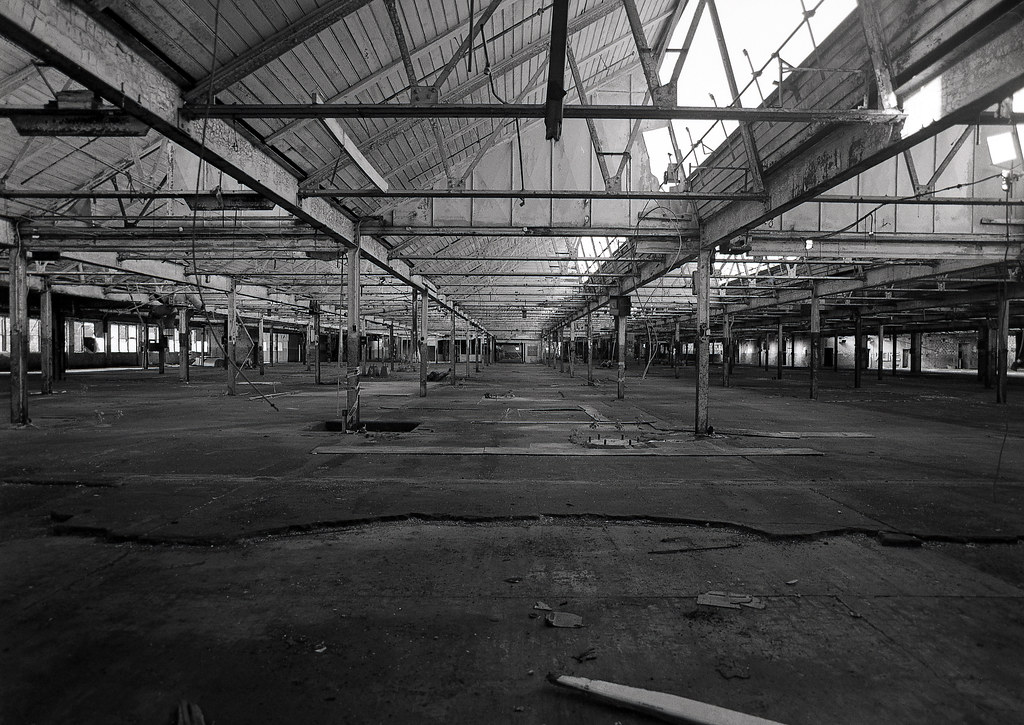

I am trying to figure out what to think on this spot, while I’m happy with the work I got here with only a single visit, it also doesn’t stick out too much in my mind. We did not go to any other locations on the trip, and an exterior trip to the HH Richardson Complex didn’t happen. After the run-in with the would-be thieves and satisfying the itch with Houdaille, we probably found a spot for dinner and beers before heading back across the border. I’m glad that at least part of the plant still stands, including the stack with the site’s name and a couple of the buildings. You can check out the rest of the photos over on Flickr.
Glossary of Terms
Polychlorinated biphenyls (PCBs): A highly carcinogenic organochlorine compound, formerly used in industrial and consumer products such as carbonless copy paper, heat transfer fluids, and as dielectric and coolant fluids for electrical equipment. Production of PCBs was banned in the United States by the Toxic Substances Control Act in 1976 and internationally by the Stockholm Convention on Persistent Organic Pollutants in 2001.
Asbestos: Asbestos is a group of naturally occurring, toxic, carcinogenic and fibrous silicate minerals. Used to create flexible objects that resist fire, including napkins, but, in the modern era, companies began producing consumer goods containing asbestos on an industrial scale. The risk of asbestos has been recognized; the use of asbestos is completely banned in 66 countries and strictly regulated in many others.
Free-phase Petroleum: Free-phase petroleum, also known as non-aqueous phase liquid (NAPL) or free product, is petroleum contamination that doesn’t mix with water. It’s usually found floating on top of groundwater because petroleum is lighter than water and can also release petroleum vapors into structures and contaminate groundwater.
Fascinating. Your Tri-X frames jump out because of the patterns of shadow and light. Well done.