By 1814, both sides were starting to tire of the war. For the Americans, they had been facing no actual movement. The Royal Navy was causing havoc on the east coast. The British held Mackinac Island, Fort Niagara, the District of Maine, and Prarie Du Chien. The Americans only held Fort Erie, having been turned back in their Niagara invasion. They were under siege and had some control of the western edge of Upper Canada but nothing beyond the settlements of Sandwich and Amherstburg. The possibility of peace negotiations had started in 1813 but were soon shut down. However, with long lines of communication between North America and Europe, news was far between and often already out of date by the time it arrived. But with parties on both sides ready to talk, commissions were drawn up and headed to Ghent.

Contax G2 – Carl Zeiss Planar 2/45 T* – Kodak Plus-X 125 – Kodak Xtol (1+1) 7:30 @ 20C
Like other wars, negotiations for a peace treaty had started while the conflict was still occurring. Earlier attempts at a mediated peace had come to nothing as Britain fought Napoleon in Europe. It was not until the summer of 1814 that both sides finally decided to come together. The city of Ghent in the United Netherlands (today Belgium) had been chosen to host the negotiations, and the diplomats began arriving in August. Being so far from home, the American delegation had senior government officials headed by John Quincy Adams with four additional commissioners. The British delegation had only three more minor officials headed by James Gambier, 1st Baron Gambier. The British delegation had shorter communication lines and could maintain near-daily contact with the British Prime Minister, Robert Jenkinson, 2nd Earl of Liverpool and the Foreign Secretary, Robert Stewart, Viscount Castlereagh. President James Madison had instructed the delegation to demand that the British end their practice of impressment and turn over Upper and Lower Canada to the United States. Adams did not present These two demands when negotiations started on 8 August. Instead, Lord Gambier presented the idea of establishing an independent state for the Indigenous peoples, with land being taken from Ohio, Michigan and northern Missouri (today Wisconsin). Great Britain would support and sponsor such a nation as it would provide a buffer state between Upper Canada and the United States and put a hold on American expansion. This idea was met with an immediate no-go from the Americans. Adams had no desire to bring a third delegation into the negotiations, especially one of Indigenous peoples. The other matter was the collapse of Tecumseh’s Confederation, which made any movement on an independent Ingenious state a non-starter. Not only did it infringe on their idea of sovereignty on Indigenous lands but also the idea of manifest destiny. Plus, it would add another British protectorate to their borders. Both sides would see this issue as a non-starter, and the peace process would be threatened to unravel. The British also felt they would soon have the leverage to force the issue as they had three invasions of the United States in progress. The first was the capture of the district of Maine, which ended with success and the re-establishment of the colony of New Ireland. While the British had succeeded in destroying Washington, DC, they had failed to capture Baltimore, a far more strategically important target. The third problem was the failure to capture Lake Champlain and Plattsburgh. This left the British with relatively minor holdings (Maine, Prairie de Chien, Fort Niagara and Mackinac Island) and the Americans with even less (Amherstburg and Sandwich). Lord Liverpool engaged Sir Arthur Wellesley, hoping to send the Field Marshall to North America and win the war. Lord Wellington had a far grimmer view of the war, stating clearly that the British were in no position to demand any land from the Americans. There was no possible way to win the war in the British favour. It also did not help that grumblings of renewed fighting with France had started circulating. Lord Castlereagh quickly informed Lord Gambier to present the idea of Status Quo, Antebellum, a return to how things were before the war started. This idea became palatable to both parties as they faced sinking public options in the war and grumblings from the merchants who were clamouring to reopen trade between the two countries to help recover the flagging economies in both nations. It became clear that neither side had the stomach for war and wanted it to end with the best possible outcome for both parties. The final treaty contained eleven articles and mentioned nothing about impressment or the annexation of Canada. Instead, it agreed to return all captured territory to how the borders were drawn in June 1812; any contested territory would be discussed in later negotiations. It also called for the return of all prisoners of war, for the British to return any enslaved persons who had joined the British during the war, and for both countries to work towards the ending of the Atlantic Slave Trade. The question of the enslaved persons would not be resolved in 1826 when the British government agreed to pay the value of the persons to the slave owners. The treaty also called for both governments to seek peace treaties with the Indigenous peoples and restore any land to them according to the 1811 treaties. On 24 December 1814, all parties affixed their signatures to the treaty; it was quickly ratified by the British Parliament and signed into law by King George III. The American government would pass the treaty unanimously, and President Madison signed it into law by February 1815. News of the end of the war had mixed reviews; the Indigenous peoples who had fought for the British were not pleased that they had been thrown under the bus in the final treaty. Many would go on to lead their rebellions against the Americans in the following years. The garrisons near the border were quickly abandoned and turned over to the original nations; those posts further away at Mackinac Island and Prairie de Chen were slightly more reluctant. However, for disputed posts, the British maintained the garrison until further negotiations would clean up the borders.

Sony a6000 – Sony E PZ 16-50mm 1:3.5-5.6 OSS
Sony a6000 – Sony E PZ 16-50mm 1:3.5-5.6 OSS
Mamiya m645 – Mamiya-Sekor C 35mm 1:3.5 N – Kodak Plus-X @ ASA-125 – Blazinal (1+25) 6:00 @ 20C
Almost as soon as the ink was dry on the Treaty of Ghent, negotiations with higher levels began solidifying and addressing the issues not included in the peace treaty. Some of the earliest treaties would clarify the ideas of fishing rights for British and American ships and reestablish friendly economic ties. Both nations would reestablish official embassies and ambassadors assigned. John Quincy Adams, the American ambassador, felt one of the biggest blocks to reestablishing regular trade was the continued presence of the wartime squadrons on the Great Lakes. The British Ambassador, Charles Baggot, with instructions from Lord Castlereagh opened up negotiations with James Monroe and later Richard Rush to begin the reduction of naval squadrons on the Great Lakes. Both men knew that total disarmament was out of the question as there were still piracy issues. Still, they sweetened the pot by stating the agreement would be an excellent cost-saving measure for the navies. The negotiations were enjoyable because they never went beyond the two men. Rush-Baggot Agreement would be signed and approved in 1817. Under the agreement, both sides agreed to reduce the size of the ships to 100 tonnes, mounting a single 18-pound gun. Each nation could operate two boats of this class on Lake Erie, Lake Huron, and Lake Superior and one ship of this class on Lake Ontario and Lake Champlain. The large squadrons were stripped of arms, sails and riggings and stored in ordinary at the naval establishments. The agreement opened more formal negotiations to determine where the border between the two nations existed. In the past, rivers and lakes provided a physical marker for the boards or agreed-upon invisible lines. While this worked well in Upper and Lower Canada, things got a bit more complex once you moved further west of the Mississippi River. Both nations maintained some colonial holdings beyond the Mississippi. Then, the idea of using the 49th Parallel was presented as a compromise. Using the line would result in both parties loose and gaining territory in the exchange. Once the sides hit the Columbia River, problems again arose; while the British maintained their hold on Vancouver Island, both claimed the entire Pacific Northwest. Eventually, it was agreed that both would administer the area jointly until further mediation could be arranged. The London Convention of 1818 would also return Moose Island to the Americans. Most conflicts were resolved by negotiation, and others were not. While treaties were being signed regularly and things began to return to normal by the 1820s, not everyone in both countries was pleased. In both Upper and Lower Canada, there remained a serious anti-American lean in the colonial governments. One of the biggest problems is that the provinces continued to be governed in a top-down model where the appointed governors had the ultimate authority. The elected body had limited authority and could be overruled without any recourse by the governor or two other appointed bodies. This resulted in the formation of a ruling elite; in Upper Canada, they were the family compact. The compact contained a small group of familiar names: William Drummond Powell, John Beverly Robertson and John Strachan. These men controlled almost every aspect of life in the province, from those who got the best land grants and purchases to those who did not. In Lower Canada, the Chateau Clique was a similar group of men with easy access to the circles of power. In both cases, they used their political power to maintain their overall power. Some decided that this power should be broken; William Lyon MacKenzie and Joseph Papineau came out as more radical leaders in the reform movement and even suggested open rebellion to overthrow the government and replace it with an American-style republic and, barring that, annexation by the United States. Open rebellion broke out in both Upper and Lower Canada in 1837. The Lower Canada rebellion became a greater threat to British rule because of their distaste for French Canadians. It resulted in far more armed engagements. In Upper Canada, a series of skirmishes resulted in a conflict between loyalist militias and rebel groups. In many cases, the rebel forces were bolstered by American volunteers who often broke American neutrality laws in crossing the border. The skirmishes were sporadic through 1837-8. By the end of 1838, all but died out as the rebel cause collapsed under poor leadership and the arrest of many involved on both sides of the border. Notably, the Aroostook War in 1838-9 around the Maine/New Brunswick Border remained a minor regional conflict that never went beyond the mobilisation of militias and fencible regiments. It never came to a direct fight. Instead, the Webster-Ashburton Treaty of 1842 cleared up the border lines in the east.

Pentax 645 – SMC Pentax A 645 35mm 1:3.5 – Kodak TMax 100 @ ASA-100 – Blazinal (1+50) 12:00 @ 20C
Mamiya m645 – Mamiya-Sekor C 150mm 1:3.5 N – Ilford HP5+ @ ASA-200 – Pyrocat-HD (1+1+100) 9:00 @ 20C
Mamiya m645 – Mamiya-Sekor C 35mm 1:3.5 N – Ilford FP4+ @ ASA-125 – Blazinal (1+25) 9:00 @ 20C
In the immediate post-war, resolving conflict through treaty negotiation was the standard, and armed conflicts were kept either regional or resolved before things went hot. However, the American Civil War was the most significant conflict that rocked North America. Most of the British Army had been withdrawn from Canada by this point in history. An entire volunteer force had replaced it. This all-Canadian army comprised an active militia in line with how the British army was organized, with regiments, battalions, and an officer corps. Even the uniforms and arms were based on British standards. A traditional sedentary militia supported these active militia units. The joint administration of the Pacific coast became a sticking point in 1844, with many Americans seeing the sharing of the coast with the British as holding back American manifest destiny. Some in the United States wanted to claim everything up to the 54th parallel. Britain wanted to hold the Americans east of the Columbia River and take everything down to the 42nd parallel. Again, the Canadians prepared for war with new defenses being built and the militia being expanded. Thankfully, it never came to that, and the 49th parallel became the defacto border with a bit of wiggling off the west coast to establish the modern boundary in 1848. But when the American Civil War exploded in the 1860s with the split of the Confederate States and the bombardment and capture of federal properties. Great Britain declared itself neutral in the conflict but allowed both sides to use British ports for the resupply of non-military items. That worked on paper, but the reality was far different. Canadians would cross the border and fight on both sides of the conflict. Confederate Agents would use Canada as a hiding place and even launched punitive raids against Union targets from across the border. This resulted in the formation of two national police forces to patrol the border and prevent any cross-border activity. It wasn’t always successful, but it did keep things to a minimum. Then, the Trent Affair happened, which nearly sent Britain and the United States into a spiralling war. The Confederate States had been desperate for recognition from major world powers and were sending ambassadors to European states. While there were some talks, relations quickly turned cold. The problems came when the Confederate government attempted to establish a formal embassy and sent a pair of diplomats past the Union blockade, eventually making it aboard RMS Trent. Captain Charles Wilkes, commanding USS San Jacinto, an overzealous Union officer, intercepted and boarded Trent, where the two men surrendered to avoid a potential war. Except when word reached London, both sides prepared for war on the US/Canadian border. Thankfully, the Trent Affair was resolved peacefully, and the two Confederate diplomats returned to London. But the entire affair left a bad taste in the mouths of Canadians. Ultimately, the Civil War resulted in the Confederates losing everything, which would stick in the minds of the Canadian government leaders and ensure that as the provinces moved towards confederation, the government would not follow a similar model as the United States. It would not, however, be the last time that things threatened to go into war; an invasion by Irish nationalists starting in 1866 to force the British Parliament to grant Irish independence by holding Canada hostage failed due to poor communication and lack of leadership of the Fenian movement. While through the remainder of the 19th Century, there was always the possibility of American annexation, it was not until the Washington Treaty of 1871 that finally resolved any outstanding disputes, including damages incurred by British-built ships serving the Confederate Navy in the Civil War along with other disputes. The Treaty would end any possibility of an American invasion of Canada.
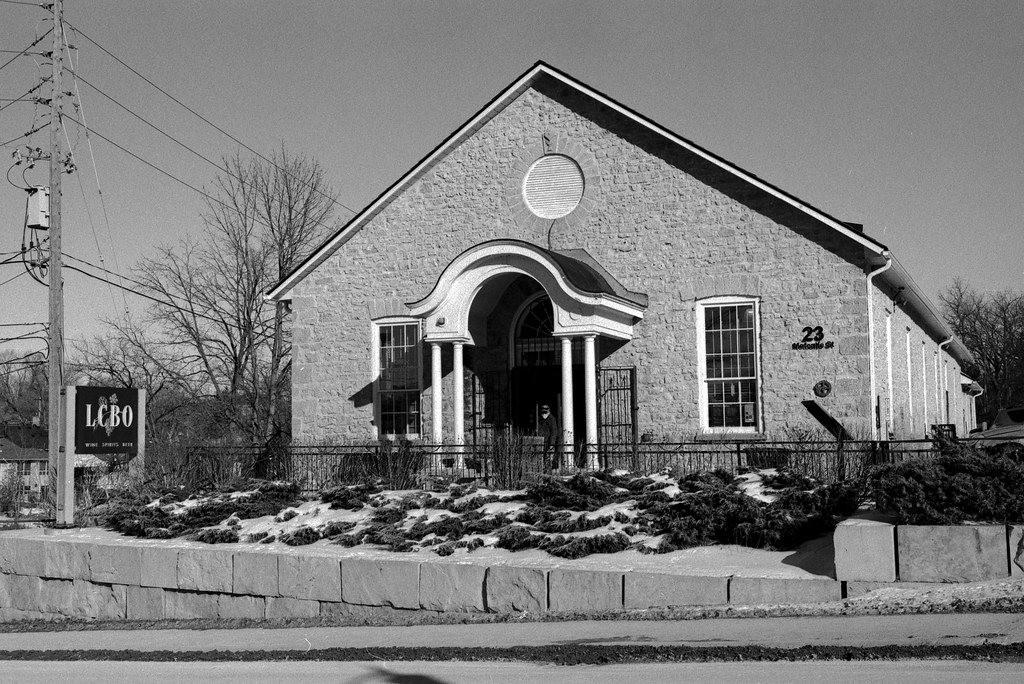
Nikon F5 – AF-S Nikkor 28-70mm 1:2.8D – JCH Streetpan 400 @ ASA-200 – Flic Film Black/White & Green (1+49) 11:00 @ 20C
Mamiya m645 – Mamiya-Sekor C 45mm 1:2.8 N – Ilford FP4+ @ ASA-100 – Kodak D-23 (Stock) 6:00 @ 20C
Sony a6000 – KMZ Helios 44M-2 2/58
History, by its nature, is complex. One of the biggest problems with studying history is that much of what we read today is all hearsay; we didn’t hear it directly ourselves, and in many cases, the authors were not present at the events. The War of 1812 is filled with myth and legend, often formed to help boost national pride and morale. However, the War of 1812 was unique because there was no winner or loser. Instead, both sides avoided losing. The British managed to hang onto a majority of Upper Canada by the end of the war, and at no point were parts of Lower Canada occupied by the Americans, so in that case, the British won, along with the local Canadian population. The Americans forced the British to repeal their Orders in Council, which hampered American trade and stopped American sailors’ impressment. Those were simply because of events in the wider Napoleonic conflict. While many held up the American desire to annex Canada, and some did see the war as a vehicle to do that, it was never the stated goal of the war. The simple matter was that neither had enough gains on both sides to force terms on the other; the reset was the only viable path to peace. The only real losers in the war were the Indigenous populations in both nations; after the war, the allies were slowly mistreated through various treaties and actions taken by the American governments along with the British Colonial authorities and later and to a greater extent, the Canadian parliament. However, the war soon became the focus of many urban myths and legends in Canadian and American identities. In Canada, chief among them is the story of Laura Secord and her connection to the Battle of Beaverdams and playing the key role in the American defeat in the battle. Laura’s story only came to light several decades after the fact and has, over the years, changed and morphed many times since then. Isaac Brock also became a folk hero among Canadians for his actions during the war. Brock’s story has also changed many times, and despite being labelled the saviour of Upper Canada, he was not fond of his posting in the backwater province. Probably chief among the myths is the militia myth; this one was repeated many times by Bishop John Strachan in the post-war period that the Canadian militia played a larger role in winning the war when, in reality, there were only a few major engagements where the militia fought and stood winning the day. Tecumseh would prove to be bigger than life, especially in his death, with many places both in Canada and the United States claiming to be the final resting place of his mortal remains. However, that outlines the major problem with the war, as the victors write history, and with Canada and the United States claiming victory, they will always make the narrative fit what they want it to say.

Modified Anniversary Speed Graphic – Kodak Ektar f:7.7 203mm (Yellow-15) – Kodak Plus-X Pan @ ASA-125 – Kodak HC-110 Dil. B 5:00 @ 20C
Pentax 645 – SMC Pentax A 645 35mm 1:3.5 – Kodak Tri-X 400 (400TX) @ ASA-200 – Kodak HC-110 Dil. E 6:30 @ 20C
Nikon D750 – AF Nikkor 14mm 1:2.8D
Like my first project related to the Anglo-American War of 1812, I never appreciated how big the subject is and how hard it can be to tell the entire story of the conflict, especially with restricting myself to telling it all in twelve posts. But at the same time, putting such big guard rails on the project also helped me narrow everything down. I could easily combine smaller actions while giving the larger ones the needed details. While this certainly is not the definitive work on the subject, I wanted to revisit everything to help guide you on your exploration of the subject and cut down the myth and legend that have built up in the retelling of the war. I also hope it inspired you to come and check out the many historic sites on both sides of the border and maybe attend a reenactment event at many of these sites. More importantly, stop and talk to the site’s reenactors and staff to get a better feel for Canadian history. Like my original project, I have written this series using a significant amount of source material. While I have not listed them on the original posts, I am including the entire list of books and websites I have used in both the original project and this one.
Guidebook to the Historic Sites of the War of 1812 Second Edition by Gilbert Collins – 2006 The Dundurn Group Publishers
Elliott, James, and Nicko Elliott. Strange Fatality: The Battle of Stoney Creek, 1813. Montréal: Robin Brass Studio, 2009. Print.
Lossing, Benson John. The Pictorial Field-book of the War of 1812 Volume 2. Gretna, LA: Pelican Pub., 2003. Print.
Hickey, Donald R. Don’t Give up the Ship!: Myths of the War of 1812. Urbana: U of Illinois, 2006. Print.
Berton, Pierre. Flames across the Border, 1813-1814. Markham, Ont.: Penguin, 1988. Print.
Berton, Pierre. The Invasion of Canada, 1812-1813. Markham, Ont.: Penguin, 1988. Print.
Hickey, Donald R. The War of 1812: A Forgotten Conflict. Urbana: U of Illinois, 1989. Print.
Malcomson, Robert. A Very Brilliant Affair: The Battle of Queenston Heights, 1812. Robin Brass Studio, 2014. Print
McCavitt, John, and Christopher T. George. The Man Who Captured Washington: Major General Robert Ross and the War of 1812. Norman: U of Oklahoma, 2016. Print.
Pullen, H. F. The Shannon and the Chesapeake. Toronto: McClelland and Stewart, 1970. Print.
Riddell, W. R. (2012). The Ancaster “Bloody Assize” of 1814. Ontario History, 104(1), 185–205. doi.org/10.7202/1065394ar
Web: Access Heritage – War of 1812 Website
Web: Historynet.com: McArthur’s Gamble: The Bold 1814 American Raid into Canada – By: Bob Gordon